 English
 Bahasa Melayu
 Suomen kieli
 عربي
عربي  Português
 Français
 Pусский
 Español
What Does gPV Mean on a Solar Fuse?


If you have ever picked up a PV fuse and seen the letters “gPV” printed on the barrel, the datasheet, or the packaging, you are looking at one of the most important pieces of information on that component—and one that is frequently misunderstood. It is not a model number, not a current rating, and not a voltage value. Understanding what gPV actually means will help you select, install, and replace solar fuses correctly.
Where You Will Find the gPV Marking
Fuse Body
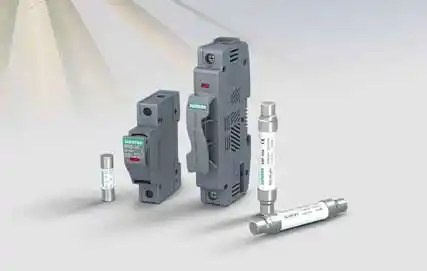
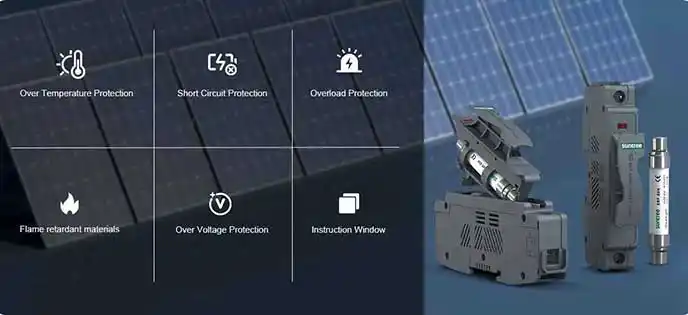
On cylindrical fuses, the gPV marking is typically printed directly on the fuse body alongside the rated current, rated voltage, and breaking capacity. On NH-style or knife-blade PV fuses, it appears on the label affixed to the fuse link. Eaton’s Bussmann series photovoltaic fuses, for example, carry “Class gPV” as a standard marking on the fuse body.
Datasheet
In product datasheets, gPV appears under the “Operating Class” or “Standard” field. A datasheet for a typical 10×38 mm PV fuse will list something like “Operating class: gPV” alongside “IEC 60269-6 (gPV)” in the standards column. This is where you confirm that the fuse is intended for photovoltaic DC protection before ordering.
Product Packaging
Manufacturers also print the gPV designation on packaging and cartons, often alongside the full standard reference—for example, “IEC 60269-6, gPV (EN 60269-6)”. This helps distributors and installers identify the correct product category without opening the fuse packaging.
What the gPV Classification Is Intended to Tell You
gPV stands for general purpose fuse for photovoltaic applications. The “g” means the fuse provides full-range protection—it responds to both overloads and short circuits across the entire current spectrum. The “PV” means it is specifically designed, tested, and rated for photovoltaic DC systems.
This classification was introduced in IEC 60269-6, the supplementary standard for fuse-links protecting solar photovoltaic energy systems, published in 2010. The standard covers fuse-links for PV strings and PV arrays in circuits with nominal voltage up to 1500 V DC, and defines requirements such as minimum breaking capacity, rated breaking capacity, and conventional times and currents.
In German-language standards documentation, the designation is explained as follows: the “g” stands for Ganzbereichssicherung (full-range fuse) and “PV” stands for the application in PV systems.
The key technical reason a dedicated PV fuse exists is the nature of DC faults. When a fault occurs in a DC circuit, there is no natural voltage zero crossing to help extinguish the arc. Only the arc overvoltage generated by the fuse can force the current to decrease to zero, which makes DC interruption significantly more difficult than AC interruption. A gPV fuse is specifically tested to handle this condition, including the low-level overloads that are typical in PV installations—a particularly arduous condition for a standard fuse.
A gPV fuse also protects against reverse currents that can occur when multiple PV strings are connected in parallel and one string develops a fault. In that scenario, the healthy strings feed current backward into the faulted string, and the gPV fuse must interrupt that reverse current safely.
What gPV Does Not Tell You
It Is Not the Fuse Current Rating
The gPV marking says nothing about how much current the fuse can carry. A gPV fuse may be rated at 2 A, 15 A, 30 A, or 600 A. The current rating is a separate number printed elsewhere on the fuse. You cannot determine the correct current rating from the gPV designation alone.
It Is Not the System Voltage
gPV does not indicate the voltage rating. While most gPV fuses today are rated for 1000 V DC or 1500 V DC, the marking itself does not tell you which. You must read the voltage rating separately—for example, “1000 VDC” or “1500 VDC”—from the fuse label or datasheet.
It Is Not a Manufacturer Model Name
gPV is a functional category defined by international standards, not a proprietary product name. Fuses from Mersen, Eaton, Bourns, SOCOMEC, and other manufacturers can all be classified as gPV, yet they will have entirely different model numbers and physical dimensions. A Bourns PF-H (gPV) series fuse and a Mersen HelioProtection HP15NH gPV fuse are both gPV-class products, but they are not interchangeable.
Other Fuse Markings That Should Be Read at the Same Time
The gPV marking is only one part of the specification. When specifying or replacing a PV fuse, you need to read these markings together:
-
Rated voltage (Un): For PV applications, this is a DC voltage rating—typically 1000 V DC or 1500 V DC. The fuse must be rated at or above the maximum system voltage, including temperature-corrected open-circuit voltage.
-
Rated current (In): The continuous current the fuse can carry without melting. In PV string protection, this is typically selected between 1.5 × Isc and 2.4 × Isc of the module.
-
Breaking capacity: The maximum fault current the fuse can safely interrupt. gPV fuses commonly offer breaking capacities of 30 kA to 50 kA at 1000 V DC, with some high-power models reaching 150 kA at 600 V DC.
-
Physical size and product model: Fuse dimensions such as 10×38 mm, 10×85 mm, or NH blade sizes determine whether the fuse will fit the holder. The product model number identifies the specific manufacturer’s part.
Why Keeping the Original Fuse Label Information Matters
When a PV fuse operates and needs replacement, the installer or maintenance technician may only have the fuse itself as a reference—the original packaging and datasheet are often long gone. If the label information has faded or been lost, it becomes difficult to confirm the correct replacement specifications.
Recording the full label information—gPV classification, voltage rating, current rating, breaking capacity, and product model—at the time of installation creates a maintenance record that saves time and reduces the risk of installing an incorrect fuse. A fuse with the wrong breaking capacity, for example, may fail to interrupt a DC fault safely, or a fuse with a different time-current characteristic may nuisance-trip under normal PV operating conditions.
For spare parts management, keeping a record of the original gPV fuse specification also ensures that replacements match the coordination study and the inverter manufacturer’s requirements. Substituting a gG fuse for a gPV fuse in a PV DC circuit is not acceptable, because gG fuses are designed for AC systems and are not tested for DC arc interruption or reverse-current protection in photovoltaic arrays.
Frequently Asked Questions
Is every DC fuse a gPV fuse?
No. A DC-rated fuse is not automatically a gPV fuse. The gPV classification is specific to photovoltaic applications and is defined by IEC 60269-6 and UL 248-19. Other DC fuse classes include aR (semiconductor protection), gR (full-range semiconductor protection), and gBat (battery storage). A fuse may be rated for DC voltage without carrying the gPV designation.
Where can I check whether a fuse is intended for PV use?
Check three places: the fuse body marking, the manufacturer’s datasheet under “Operating Class” or “Standards,” and the product packaging. A PV fuse will typically reference IEC 60269-6, UL 248-19, or both. If the datasheet does not mention a PV standard, the fuse is not classified as gPV.
Can I identify a PV fuse only by its physical size?
No. Physical size tells you whether the fuse will fit the holder, but it does not tell you the operating class, voltage rating, or current rating. A 10×38 mm fuse body can contain a gPV fuse, a gG fuse, or an aR fuse, all with the same dimensions but entirely different electrical characteristics. You must read the markings to confirm the class.
What to Record Before Ordering a Replacement
Before ordering a replacement PV fuse, record the following from the existing fuse and its documentation:
-
Operating class: gPV (or other class, if applicable)
-
Rated voltage: 1000 V DC or 1500 V DC
-
Rated current: 15 A
-
Breaking capacity: 30 kA at 1000 V DC
-
Physical size and product model: 10×38 mm, manufacturer part number
-
Application location: string fuse, array fuse, combiner box, or main fuse
-
Site equipment information: inverter make and model, module specifications, and string configuration
Having these details on hand allows you to cross-reference the replacement against the original specification and confirm that the new fuse matches both the electrical requirements and the physical installation.