 English
 Bahasa Melayu
 Suomen kieli
 عربي
 Português
 Français
 Pусский
 Español

How to resolve condensation inside a solar combiner box


You open the door after a cool night and find fine droplets across the inner cover, or a shallow bead of water sitting at the bottom of the enclosure. There is no obvious rain track, no torn gasket, and no recent storm. Yet moisture is inside.
The immediate answer to why is there condensation inside a solar combiner box is this: warm, moisture-bearing air trapped inside the enclosure cools at night until its temperature falls below the dew point on colder internal surfaces—metal backplates, DIN rails, fuse holders, or the inner face of the cover. Condensation is a thermal-and-humidity event, not automatically proof that the IP rating has failed. An IP65 enclosure can still develop internal dew because the IP test addresses external dust and water jets, not the dew point of the air already inside. The practical consequence is equally important: before changing hardware, separate condensation from direct water entry. The sections below provide the inspection sequence, the component-level evidence to collect, and the boundaries of what sealing, venting, and heating can—and cannot—solve.
What Does Condensation Look Like Inside a Combiner Box?
Pattern and location are the first diagnostic evidence. Do not wipe the enclosure before recording them. Record the pattern before wiping the enclosure; this is the first step in how to inspect a solar combiner box before wiping the enclosure on a site with daily thermal cycling.
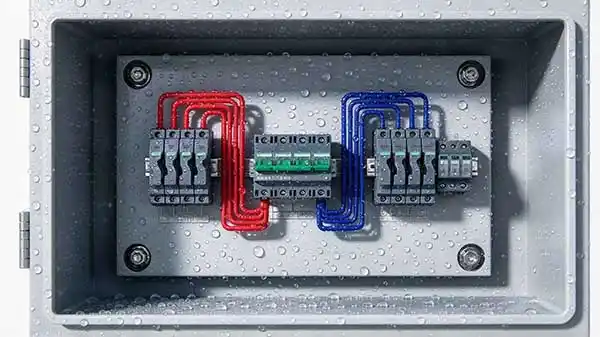
Fine Droplets Across the Inner Cover
A uniform distribution of small droplets on the inner cover, upper sidewalls, or exposed metal surfaces is the classic signature of dew formation. It typically appears after a sharp temperature drop and is densest on surfaces that cool fastest—often the enclosure skin rather than the bulk internal air. This pattern points toward thermal cycling and internal humidity, not a failed gasket.
Water Collecting at the Bottom of the Enclosure
Water at the bottom is evidence of accumulation, not yet a diagnosis. It may be condensed dew that has run down internal surfaces over successive cycles, or it may be liquid water that entered from outside and travelled downward. The presence of bottom water alone does not distinguish between the two. Record the water level, whether the bottom is uniformly wet or locally pooled, and whether the cable entry area shows staining or run marks.
Water Tracks Around a Cable Entry
A localized track below a gland, a streak from an unused opening, or dust displacement along a sealing surface is a stronger indicator of an external water path. Condensation tends to be surface-wide; ingress tends to be path-directed. If the water is concentrated at one entry point and the rest of the enclosure is relatively dry, the inspection priority shifts from dew-point management to cable-gland installation and sealing integrity.
Why Can Condensation Form Even in a Sealed Enclosure?
A sealed enclosure is not a dehydrated enclosure. The air trapped at assembly carries water vapour, and the enclosure “breathes” through pressure changes even when liquid water cannot pass.
Hot Day and Cool Night Temperature Cycling
During the day, solar irradiance and component heat raise the internal air temperature. Warmer air holds more vapour. At night, the enclosure skin cools faster than the internal air. When the skin temperature drops below the internal dew point, vapour changes to liquid on the coldest available surfaces. In PV fields this cycle can repeat every 24 hours, so a small initial moisture load becomes a recurring reliability problem.
Humid Air Already Trapped Inside the Box
The initial moisture load may be present from the moment of closure. Installation in humid conditions, storage without desiccant, or commissioning before the enclosure is fully dried can leave water vapour inside. An IP65 rating does not prevent that trapped vapour from condensing later when the temperature falls.
Pressure Changes During Heating and Cooling
Heating expands internal air and forces a small volume outward through gasket micro-gaps and cable entries. Cooling contracts the air and draws ambient moisture back in through the same paths. This “pumping” effect means that repeated thermal cycles can gradually increase internal humidity even without a visible seal failure. A breather or pressure-equalization device can reduce this uncontrolled exchange, but it must match the DC combiner box selection for high-humidity PV sites enclosure design and mounting orientation. It does not dry the enclosure by itself.
Where Should You Look for Possible Moisture Entry?
Inspection should follow the order of probability: entries first, sealing surfaces second, unused openings third. The goal is to collect evidence, not to replace parts preemptively.
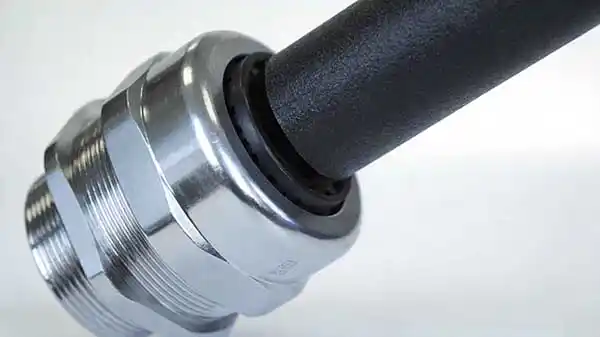
Cable Glands and Cable Entry Points
Check that each gland matches the cable diameter, that the sealing insert is compressed, and that the entry is from the bottom or side where water cannot run along the cable into the box. A gland that is tight to hand pressure may still be loose under thermal cycling. Look for water tracks on the inside face below the entry; a clean track with dust displacement is more consistent with ingress than with condensation.
Door Gaskets and Sealing Surfaces
Gaskets harden and lose compression over time, and UV exposure accelerates the process. Run a finger along the gasket to feel for flat spots, cracks, or permanent deformation. Check the mating surface for paint damage, grit, or debris that can create a capillary path. A gasket that looks intact but has lost elasticity may still allow pressure-driven vapour exchange.
Unused Openings and Mounting Holes
Every unused knockout, mounting hole, or spare cable entry is a potential path. Blanking plugs must be rated for the enclosure and installed with the correct sealing washer. A missing or loose blanking plug is a direct ingress point, but even a correctly installed plug can become a vapour path if its seal degrades.
Which Components Are Most Affected by Repeated Moisture?
Moisture damage in a combiner box is cumulative. The components most sensitive to repeated wetting are the ones with fine metallic contact surfaces and voltage stress.
Fuse Holders and Terminals
Fuse holder contacts and terminal screws are vulnerable to surface corrosion and increased contact resistance. Moisture films can form a resistive layer that heats under load, accelerating oxidation. Inspect for discoloration, white or green corrosion products, and any sign of overheating at the fuse clips.
DC SPD Connections
Surge protective devices have sensitive internal metal-oxide elements and connection points. Moisture contamination at the SPD terminals or within the module can degrade clamping performance or create leakage paths. A red or yellow status window on the SPD is not proof of moisture causation, but repeated moisture exposure is a legitimate reason to inspect the SPD terminations and enclosure environment. For component selection, see selecting a DC SPD for a combiner box exposed to repeated moisture.
Breaker Terminals and Busbars
Busbars and breaker terminals are often the coldest metallic masses during rapid cooling, making them preferred condensation surfaces. Water films on busbars can bridge insulation gaps and promote tracking. Look for water marks, dull spots on tinned surfaces, and any evidence of arcing near terminal boundaries. Moisture-related terminal heating should also be checked together with protection coordination—see why a solar combiner box needs both a DC MCB and a DC SPD.
Why the Installation Location Can Make Condensation Worse
The same enclosure can perform differently on two sides of the same array. Location changes the thermal cycle amplitude and the moisture availability.
Direct Sun Followed by Rapid Evening Cooling
An enclosure in direct sun absorbs solar gain and reaches a higher daytime internal temperature than a shaded box. The larger the day–night temperature swing, the deeper the internal surfaces fall below the dew point at night. Shading or a weather roof reduces the daytime peak and narrows the dew-point margin required.
Shaded and Humid Locations
A shaded location reduces solar gain but may not reduce humidity. In coastal, agricultural, or valley sites, ambient relative humidity can remain high while the enclosure runs cooler. The dew point of the internal air is then closer to the enclosure surface temperature, so even a modest overnight drop can trigger condensation.
Areas Close to Wet Ground or Roof Drainage
Enclosures mounted low on a wall, near roof drainage outlets, or in poorly drained areas are exposed to splashing and to humid air near saturated surfaces. Ground-level mounting also increases the chance that cable conduits act as moisture paths. Where practical, raise the mounting height and keep the enclosure away from direct drainage flow.
What Can Reduce Recurring Condensation?
The corrective strategy depends on whether the dominant problem is uncontrolled air exchange, a persistent internal moisture load, or an external entry path. A single measure rarely solves all three.
Verify sealing integrity first. Tighten or replace cable glands, confirm gasket compression, and fit rated blanking plugs to every unused opening. Sealing is the baseline; without it, venting or heating will be fighting a continuing moisture supply.
Use a pressure-equalization breather where the design allows. A membrane breather can reduce the pressure-driven pumping of humid air through gaskets and entries while maintaining the enclosure’s IP rating in the specified mounting orientation. It is not a dryer: it manages pressure, not internal moisture content.
Consider an anti-condensation heater only where the thermal budget and control strategy justify it. A PTC heater can keep internal surfaces above the dew point in small, tightly sealed enclosures with a reliable power supply. It should be treated as an engineered option, not a universal fix; in large combiner boxes with limited internal heat generation, heating may be impractical.
Do not drill additional holes to “let moisture out.” An uncontrolled opening defeats the IP rating and can create a new liquid-water path. Any ventilation or drainage feature must be a rated component installed at the manufacturer-approved location and orientation.
For Suntree combiner boxes, the published operating condition is 95% relative humidity with no condensation. That is a rating boundary, not a guarantee that every field installation will remain below the dew point. Suntree’s project-support position is to treat moisture as a system issue—sealing, cable-entry layout, pressure management, installation location, and inspection evidence—so that the remedy matches the cause rather than replacing the enclosure by default.
Frequently Asked Questions
Can an IP65 combiner box still develop condensation?
Yes. IP65 addresses external dust and water-jet ingress under defined test conditions. It does not control the dew point of the air inside the enclosure. Fine droplets on the inner cover of an IP65 box can form without any external water entry.
Does condensation always mean the combiner box is leaking?
No. Condensation and leakage are different mechanisms. Condensation produces relatively uniform surface droplets after a temperature drop; leakage tends to produce localized tracks, staining, or pooling near a specific entry or sealing defect. The two can coexist, but neither proves the other.
Should a combiner box be replaced if moisture is found inside?
Not automatically. Replacement is justified when the enclosure is structurally compromised, the gasket seat is damaged beyond repair, or corrosion has degraded busbars and terminals beyond cleaning. In many cases, the first corrective action is to restore sealing integrity, verify cable entries, and, where appropriate, add pressure equalization or a heater per the manufacturer’s design.
Summary and Next Action
Condensation inside a solar combiner box is a dew-point problem, not an automatic IP failure. The diagnostic sequence is: record the pattern, separate uniform dew from path-directed ingress, check cable entries and gaskets, and then match the remedy—sealing, pressure equalization, or thermal management—to the dominant cause. The boundary is equally clear: an IP65 enclosure can still condense, and a higher IP rating alone does not solve internal humidity. Please contact us promptly for after-sales service!