 English
 Bahasa Melayu
 Suomen kieli
 عربي
عربي  Português
 Français
 Pусский
 Español
Why Does My Solar Combiner Box Need Both a DC MCB and a DC SPD?


In any PV system, the DC combiner box is the critical node where multiple PV strings are aggregated and fed to the inverter. Open any properly designed combiner box and you will find two devices side by side: a DC MCB (miniature circuit breaker) and a DC SPD (surge protective device). This is not over-engineering by the equipment manufacturer, nor is it redundant functionality—they protect against completely different threats, and both are indispensable.

Simply put: the DC MCB protects the circuit against overcurrent, while the DC SPD protects the equipment against overvoltage. One is for “fire prevention,” the other is for “lightning protection.”
One Protects Against Overcurrent – The DC MCB
What Threat Does It Address?
The DC MCB responds to sustained excessive current—that is, overcurrent faults.
Common sources of overcurrent in PV systems include:
-
String short circuits: accidental contact between positive and negative conductors of a PV string, generating a massive short‑circuit current.
-
Inverter faults: internal failures in the inverter that cause current backflow or abnormal increases.
-
Reverse current: in a multi‑string parallel system, when one string fails, current from healthy strings can back‑feed into the faulty one.
-
Incorrect wiring or additional loads: causing the circuit current to exceed the design value.
The common feature of these faults is that the current persists above the rated value, leading to cable overheating, insulation degradation, and ultimately fire risk. The DC MCB’s job is to disconnect the circuit when such faults occur, preventing disaster from escalating.
How It Works
The DC MCB employs a thermal‑magnetic tripping mechanism, detecting overcurrent in two ways:
-
Thermal tripping: when the current exceeds the rated value but is not yet at short‑circuit levels, a bimetallic strip bends due to heating and, after an inverse‑time delay, triggers the tripping mechanism. The higher the current, the faster the action.
-
Magnetic tripping: when a severe short circuit occurs and the current spikes to several times the rated value, the electromagnetic coil generates sufficient magnetic force to instantly pull the tripping mechanism.
It is worth noting a fundamental difference between DC and AC systems: DC current has no natural zero‑crossing point, so the arc generated when breaking a DC circuit is much harder to extinguish. A qualified DC MCB must be equipped with dedicated arc‑extinguishing features to safely interrupt DC fault currents.
The Other Protects Against Overvoltage – The DC SPD
What Threat Does It Address?
The DC SPD responds to momentary high‑voltage surges—transient overvoltages that last only microseconds but reach extremely high voltages.
Surge sources fall into two main categories:
-
Lightning strikes: even if lightning does not directly hit the PV array, a distant strike can induce thousands of volts onto the DC cables. PV string cables are typically long and widely distributed, making them highly susceptible to induced surges.
-
Switching overvoltages: switching operations in the grid, relay tripping, inverter transitions, and other events can also generate high‑amplitude voltage spikes.
These surges are extremely short but have very high voltages—enough to puncture the insulation of inverters, electronic components inside the combiner box, and even PV modules. Importantly, the SPD protects equipment, not cables—sensitive electronic components such as IGBTs, monitoring modules, and communication interfaces in the inverter have much lower insulation withstand capability than cables.
How It Works
The core element of a DC SPD is the Metal Oxide Varistor (MOV). Its operation can be summarised in three stages:
-
High impedance under normal conditions: at the system’s normal operating voltage, the MOV presents a very high resistance, allowing only a tiny leakage current, with negligible impact on the system.
-
Low‑impedance trigger during a surge: when a lightning or switching overvoltage pushes the voltage above the SPD’s threshold, avalanche breakdown occurs inside the MOV, and its resistance drops sharply to near‑conductor levels.
-
Energy discharge and recovery: a low‑impedance path is formed to divert the massive surge current to the grounding system. After the surge passes and the voltage returns to normal, the MOV automatically reverts to its high‑impedance state.
A high‑quality DC SPD typically has a response time in the nanosecond range, enabling it to act before the surge peak arrives, clamping the overvoltage to a safe level. The SPD also incorporates an internal thermal disconnector—when the MOV ages and overheats from repeated surges, it automatically disconnects the SPD from the circuit, with a visual indicator to signal failure.
They Cannot Replace Each Other
Once the operating principles are understood, a key question arises: can they substitute for each other? The answer is no.
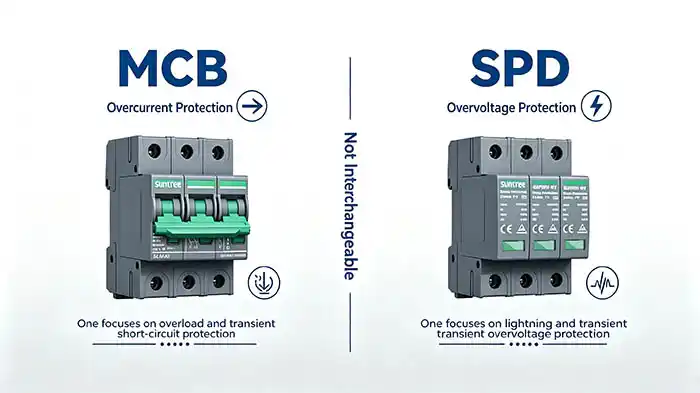
Can a DC MCB stop a lightning surge? – No.
The DC MCB operates in the millisecond range. A lightning surge, however, lasts only microseconds—the SPD acts in nanoseconds.
What does this mean in practice? When a surge occurs, the MCB has no time to react before the surge has already passed—but within those few microseconds, thousands of volts have already punctured the inverter’s electronics. The equipment is damaged, yet the MCB never trips.
The MCB is “slow”; the SPD is “fast.” Using an MCB to guard against surges is like using a fire hose to stop a bullet—by the time it responds, the damage has already been done.
Can a DC SPD stop an overcurrent? – No.
Conversely, the SPD is sensitive only to voltage; it has no response capability to sustained overcurrent.
If a string short circuit occurs and the current keeps rising, the MOV inside the SPD remains in its high‑impedance state at normal voltage—it simply does not “sense” the overcurrent and takes no action.
Even more dangerous: if an SPD fails in a short‑circuit mode due to ageing or after repeated surges, it itself becomes a sustained overcurrent path. Without an MCB or fuse to interrupt that faulty branch, the SPD will continue to heat up and may eventually cause a fire.
How They Work Together in a Real Scenario
Now consider a real scenario: a lightning strike hits a transmission line near the PV plant.
- The SPD acts first: the lightning induces a surge voltage of thousands of volts onto the DC cables. The MOV inside the SPD conducts in nanoseconds, diverting the surge energy to earth and clamping the voltage to a safe level. The inverter and the electronics inside the combiner box survive.
- If the surge energy is extreme: in exceptional cases, a single massive surge may exceed the SPD’s capability, causing the MOV to degrade or even short‑circuit. At that point, the SPD changes from a protective device into a fault point—it becomes a continuous conduction path, creating a short‑circuit current.
- The MCB provides back‑up protection: once the SPD fails short, a sustained overcurrent appears in the circuit. The MCB, connected in series upstream of the SPD, detects this overcurrent and trips via thermal or magnetic action, disconnecting the circuit. The fault is isolated, and fire is avoided.
This coordination is known in engineering as “back‑up protection” —the MCB not only protects the line against overcurrent but also serves as the last line of defence when the SPD fails.
What Happens If You Have Only One of Them?
Only MCB, No SPD
When lightning strikes, the surge voltage hits the combiner box and inverter at microsecond speed. The MCB’s response time is in milliseconds—before it can even react, the surge has already passed, but the sensitive components inside the inverter have already been punctured.
The result: equipment damage and system downtime. The MCB never trips, because it simply had no time to respond. You might wonder, “why didn’t the MCB trip, yet the equipment is broken?” —the answer is: the MCB does not protect equipment against overvoltage; it only protects the circuit against overcurrent.
Only SPD, No MCB
If the combiner box contains only an SPD without an MCB, the situation is equally dangerous.
SPDs have a finite lifespan. Each surge slightly ages the MOV. When the SPD ages to the point of short‑circuit failure, it changes from high impedance to low impedance and conducts continuously.
At this point, without an MCB to interrupt that short‑circuit current, the SPD will keep heating up. Over time, it can burn the combiner box or even the entire distribution cabinet. The SPD protected the equipment once, but without an MCB, it can eventually become the cause of a fire.
Frequently Asked Questions
Q1: Can I use a combined device that does both?
There are indeed “combined protector” products on the market, but they are essentially two independent modules housed in a single enclosure, not a single functional device that can perform both overcurrent and surge protection. Functionally, they are still an MCB + SPD combination, not a replacement for either.
Q2: Does the MCB need to be installed before or after the SPD?
In typical combiner box design, the SPD is installed on the load side of the MCB. This arrangement ensures that when the SPD fails short, the MCB detects the overcurrent and trips, isolating the SPD branch—providing back‑up protection.
Q3: Do all combiner boxes require both?
Overcurrent protection (MCB or fuse) is mandatory—most electrical codes require combiner boxes to have overcurrent protection.
SPD requirements depend on the installation environment and code version. NEC 2023 added Section 690.4(F), mandating Type 2 SPDs at the DC input of PV systems under certain outdoor installation conditions. Even where not required by code, for outdoor PV installations, an SPD is highly recommended—lightning does not stop just because you did not install one.
Summary & Next Steps
Returning to the original question: why does a combiner box need both a DC MCB and a DC SPD?
Because they address two fundamentally different types of threats:
| DC MCB | DC SPD | |
|---|---|---|
| Protects | Cables | Equipment |
| Threat addressed | Sustained overcurrent | Transient overvoltage |
| Response time | Milliseconds | Nanoseconds |
| Failure consequence | Cable overheating and fire | Electronic equipment breakdown |
They are complementary, not substitutable. One protects the circuit from burning, the other protects the equipment from being punctured. They work together—the SPD fights surges on the front line, while the MCB provides back‑up protection in the rear—to form a complete protection system for the combiner box.
In a PV system, omitting either protective device is gambling with system safety and reliability.
This article is for informational purposes only. For specific selection and installation, always follow local electrical codes and the equipment manufacturer’s technical requirements.