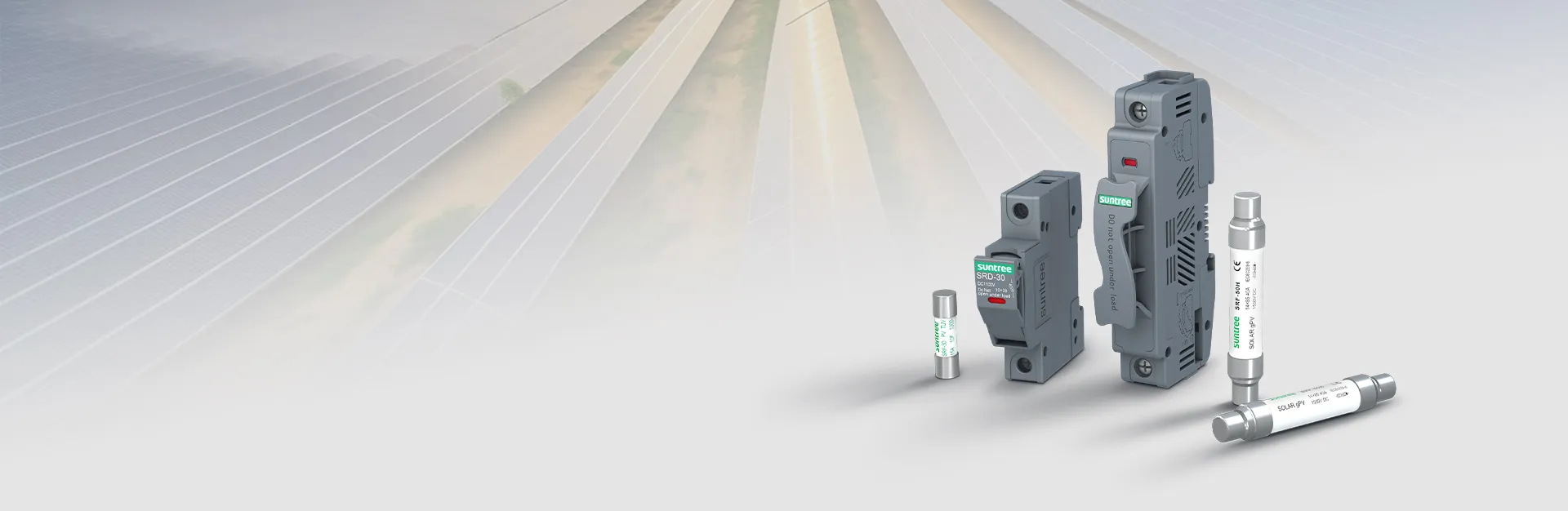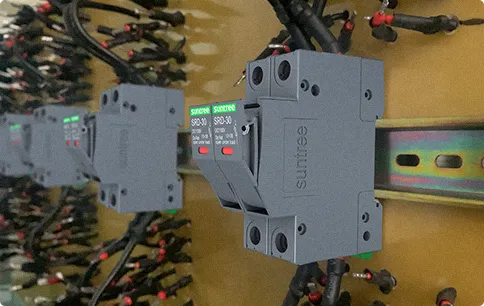


According to PV system design standards, the fuse rated current should be selected as follows: the rated current should be greater than the PV string short-circuit current (Isc), typically 1.25 to 1.5 times Isc. This is because PV modules may generate currents exceeding Isc due to variations in sunlight intensity during normal operation. Suntree PV fuses are available in a rated current range from 2A to 630A, meeting the needs of different scales of PV systems. For example, the SNHPV series covers 50-630A for combiner box applications; the SRD-30 series covers 1-32A for small string protection.
The fuse blown indication function on Suntree DC fuses is primarily achieved through an indication window design. The working principle is as follows: when the fuse link is functioning normally, the indicator light is off; when the fuse link blows due to overcurrent or short-circuit faults, the indicator light turns on, signaling that the fuse link needs replacement. Some fuse holders also offer optional remote signaling contacts, allowing the blown status signal to be transmitted to a monitoring system for remote detection.
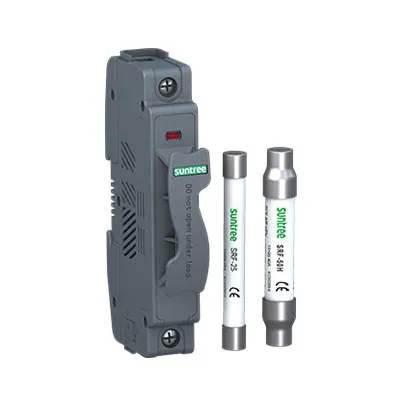
Suntree's SRD-50H series fuse-disconnector features key specifications including rated insulation voltage of 1500V, rated operational voltage of DC 1500V, rated operational current of 50A, impulse withstand voltage of 6kV, rated limited short-circuit current of 20kA, and IP20 protection rating. These products are suitable for energy storage systems, PV power plants, battery bank protection, and other new energy power distribution applications.
Suntree NH series fuses are classified into NH00, NH0, NH1, NH2, and NH3 by size and capacity. The NH000/NH00 specification has a rated current range of 6-160A and dimensions of approximately 78×51×15mm. The NH0 specification offers 6-160A with dimensions of 125×68×15mm. The NH1 specification offers 32-250A with dimensions of 135×68×20mm. The NH2 specification offers 80-400A with dimensions of 150×68×25mm. The NH3 specification offers 160-630A with dimensions of 150×68×32mm.
A fuse disconnector is a combined device that integrates a fuse and a disconnector into a single unit, combining three major functions: protection, isolation, and maintenance. The fuse provides overcurrent and short-circuit protection, while the disconnector provides safe disconnection with a clear isolating gap. When the switch is in the "OFF" position, the internal contacts physically separate, creating a visible break and ensuring complete de-energization of downstream circuits. This allows operators to safely isolate a faulty section for inspection and maintenance without having to shut down the entire system.
The main difference lies in whether it has a switching and isolating function. A standard fuse holder is only used to secure and connect the fuse, providing overcurrent protection but without the ability to manually open or close the circuit; the circuit must be de-energized before replacing the fuse. In contrast, a fuse switch disconnector integrates a switching mechanism on top of the fuse holder. Operators can manually make or break the circuit under load using the handle, while also providing a visible isolating gap. This offers higher safety and easier maintenance, making it suitable for applications that require frequent circuit isolation.
GET A QUOTE