 English
 Bahasa Melayu
 Suomen kieli
 عربي
 Português
 Français
 Pусский
 Español

How a DC MCB can be mounted sideways or upside down


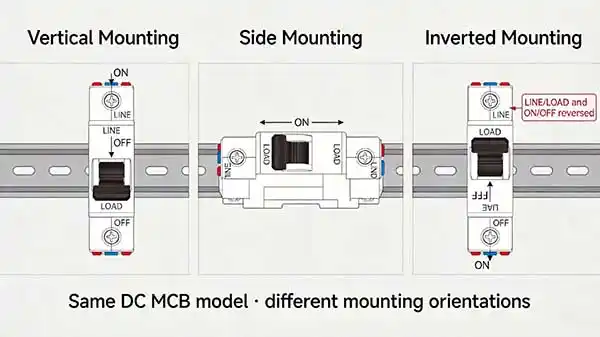
Can a DC MCB be mounted sideways? The short answer is: not as a blanket rule. Some DC MCBs are explicitly rated for any mounting position; others are restricted to vertical or horizontal on a vertical plane. The deciding factor is not panel space—it is what the specific product’s instructions and datasheet say about mounting orientation, terminal polarity, and the direction of the operating handle.
Why Mounting Orientation Is Product-Specific
Internal Trip Mechanism and Product Design
A DC MCB interrupts direct current, and DC arcs do not self-extinguish at a current zero the way AC arcs do. Most polarised DC MCBs therefore place permanent magnets near the arc chutes to drive the arc into the splitter plates. ABB states this directly for its DC miniature circuit breakers: permanent magnets are present in the arc-chute area, so polarity must be taken into account during installation; with top-fed devices, terminal 1 must be connected to (−) and terminal 3 to (+), because incorrect polarity may damage the MCB. The mounting position does not change the physics of the arc, but an upside-down or sideways installation changes the physical relationship between the terminals, the internal current path, and the installer’s reading of the device. That is why orientation is tied to product design rather than being a universal panel-building freedom.
Manufacturer Installation Instructions
The datasheets show a genuine split across the market. On the permissive end, ABB’s SU200DC datasheet lists Mounting position: Any under general technical data, and the SB200 DC documentation likewise records Mounting position: Any for IS/IEC 60947-2. Eaton’s FAZ-DC series datasheet lists Mounting position: As required. Legrand’s DX3 DC MCB documentation is more explicit still, listing Operating positions: Vertical, Horizontal, Upside down, On the side.
On the restrictive end, EKF’s AV-6 DC technical manual states Position in space: vertical or horizontal on a vertical plane, and adds that if installed vertically, the upper position of the operating handle must correspond to ON and the lower position to OFF, in compliance with IEC 60447. Other products are silent or effectively vertical-only. A panel builder who treats every DC MCB as “any position” will eventually meet a device that does not permit it.
Certification and Datasheet Requirements
IEC 60947-2 does not impose a single permitted mounting orientation across all DC MCBs. What it does require is that the direction of operation normally conform to IEC 60447, and where devices cannot conform—for example because of special applications or alternative mounting positions—they must be clearly marked so that there is no doubt as to the “I” and “O” positions and the direction of operation. In practice, this means a sideways or upside-down installation is permissible only within the envelope the manufacturer has declared and marked. UL 489 products add another layer: Eaton’s documentation notes that circuit breakers are marked “Line” and “Load,” and that line and load connections may be reversed only where the marking and listing accept that reversal. The datasheet, not the DIN rail layout, is the governing document.
What Should Be Checked on the Breaker Before Changing Orientation?
LINE and LOAD Markings
Before rotating the device, read the terminal markings. On polarised DC MCBs, the positive and negative terminals are not interchangeable. Schneider Electric states for its DC MCBs that the positive and negative poles must not be reversed, because the arc is drawn into the arc chute by magnets and the current direction must be correct for effective arc extinction. Legrand’s DX3 DC MCB datasheet is especially instructive: it permits four operating positions, yet also states Power supply: Only from the top as shown in the wiring diagram. “Sideways” in the mechanical sense does not necessarily mean “feed from any terminal.” A sideways or upside-down body must still respect the LINE and LOAD side the manufacturer specifies.
ON and OFF Handle Indication
The handle must remain unambiguous after reorientation. IEC 60447 establishes the normal convention: for vertical operation, upward is ON; for horizontal operation, movement to the right is ON. If a breaker is turned upside down, the handle may still physically toggle, but the relationship between handle position and the “I”/“O” markings on the body can become counter-intuitive. IEC 60947-2 anticipates this: where the actuator cannot conform to the normal direction because of an alternative mounting position, the device must be clearly marked so that the ON and OFF positions and the direction of operation are not in doubt. If the marking is not adequate for the new orientation, the installation is not acceptable, regardless of whether the breaker will still trip.
DIN Rail Mounting Instructions
DIN rail mounting itself is mechanically symmetrical on 35 mm rail to EN 60715, but that symmetry does not override the manufacturer’s operating-position declaration. A breaker rated “Any” can be clipped in any orientation; a breaker rated “vertical or horizontal on a vertical plane” cannot be turned upside down simply because the clip still engages the rail. The mechanical fit is necessary but not sufficient.
What Changes When the Breaker Is Mounted Sideways?
Cable Routing and Bend Space
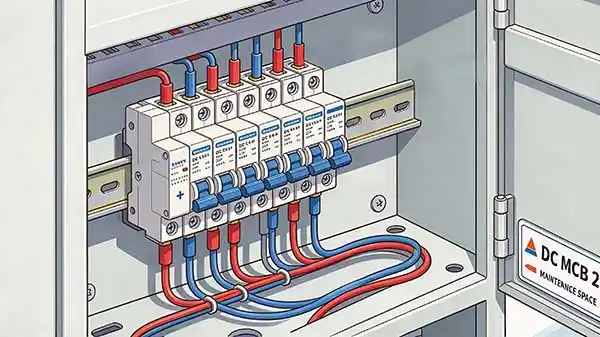
Sideways mounting changes which side of the breaker the cable approaches from. In a vertical installation, top-fed LINE conductors and bottom-fed LOAD conductors have a predictable bend radius. Rotate the breaker 90°, and the terminal openings now face left and right rather than up and down. In a dense enclosure, this can force a tighter bend radius on the conductor or push the cable against an adjacent component. For large conductor sizes, the minimum bend radius can become the limiting factor before the breaker’s electrical rating does.
Label Visibility
A sideways breaker presents its front label rotated relative to the panel’s normal reading direction. Polarity symbols, the LINE/LOAD designation, and the “I”/“O” markings remain physically present, but the person tracing a circuit during maintenance may have to tilt their head or rotate a drawing. This is not an electrical failure, but it is a human-factors change that panel builders should account for in labelling and documentation.
Access for Future Testing
Sideways mounting can improve or degrade access to the terminals for torque checking and thermographic inspection. If the rotation places the terminal screws against an adjacent module or toward the enclosure wall, future maintenance access may be worse than in the standard vertical position. The orientation decision should therefore be made with the maintenance phase in mind, not only with the build phase.
What Can Go Wrong with an Upside-Down Installation?
The most common errors in an upside-down installation are identification errors, not immediate trip failures. The breaker may still switch and trip, but three things can become misleading. First, the ON/OFF handle relationship can invert relative to the panel’s normal convention: an operator accustomed to “up = ON” may read the handle incorrectly. Second, the LINE and LOAD direction can be misread if the installer assumes that “LINE is always at the top.” On a polarised DC MCB, feeding the wrong terminal can compromise arc extinction; Schneider Electric’s position is unambiguous that the positive and negative poles must not be reversed because the arc must be magnetically driven into the arc chute. Third, the label and any polarity markings are read upside down, increasing the chance of a future maintenance error.
This is not a claim that every upside-down DC MCB will fail. Products with Mounting position: Any are designed and declared for that use. The risk is concentrated in products that are not declared for upside-down service, and in installations where the terminal direction or handle convention is not re-checked after rotation.
How Panel Heat Should Influence the Layout
Nearby Heat-Producing Components
A DC MCB’s thermal trip element responds to the temperature inside the breaker, not only to the current through it. If a sideways or upside-down breaker is placed immediately beside a transformer, a power supply, or a contactor coil that dissipates heat, the bimetal can reach its trip threshold at a lower current than it would in free air. The orientation itself does not create the heat, but a non-standard orientation can make it harder to notice that the breaker has been placed in a thermal shadow or a hot zone.
Tight Breaker Spacing
Grouping matters more than rotation in many panels. The IET’s guidance on grouped circuit-breakers notes that breakers serving continuous loads may require derating when placed adjacent to other continuously loaded breakers, because of mutual thermal influence. A sideways row of fully loaded DC MCBs can trap heat between modules just as a vertical row can. The orientation change should not be used as an excuse to ignore the manufacturer’s derating tables or the rated diversity factor for grouped devices.
Enclosure Ventilation Conditions
An upside-down breaker near the top of an enclosure may sit in a different airflow path than the same breaker mounted vertically at the bottom. If the enclosure relies on convection, rotating a breaker changes the surface available to rising air and can alter the local ambient temperature around the bimetal. The practical check is to confirm that the ambient temperature at the breaker’s new location remains within the reference temperature used for its trip characteristics, and to apply the manufacturer’s ambient-temperature derating where it is not.
When the Standard Vertical Position Is the Better Choice
If the datasheet does not explicitly list sideways or upside-down as an operating position, the standard vertical position is the defensible choice. This is not because vertical mounting is electrically superior in every case, but because the installer then operates inside the envelope the manufacturer has declared and tested. The same logic applies when the instructions are ambiguous, when the product is polarised and the LINE/LOAD direction would become confusing after rotation, or when the panel’s maintenance procedures assume “up = ON.” In those situations, changing the DIN rail layout or selecting a product rated Mounting position: Any is a lower-risk solution than rotating a breaker whose documentation does not support the orientation.
Frequently Asked Questions
Can a DIN rail DC MCB be installed horizontally?
Some can, and some cannot. ABB’s SU200DC and SB200 DC datasheets declare Mounting position: Any, which includes horizontal. Legrand’s DX3 DC MCB lists Horizontal among its operating positions. But EKF’s AV-6 DC permits only vertical or horizontal on a vertical plane, and many polarised DC MCBs are effectively vertical by instruction. The DIN rail clip will hold the breaker in a horizontal position in every case; the question is whether the product is declared for it.
Does upside-down installation affect breaker operation?
It can affect the interpretation of operation even when the trip mechanism still functions. IEC 60947-2 requires that where an alternative mounting position makes the actuator direction non-standard, the device must be clearly marked so that the I and O positions and the direction of operation are unambiguous. A breaker declared for any position can be upside down safely; a breaker not declared for it should not be rotated merely because the handle still clicks.
Should the wiring direction follow the terminal markings?
Yes. The terminal markings are the primary wiring instruction, and they survive a change of mounting orientation. Legrand’s DX3 DC MCB permits sideways and upside-down operating positions, but still specifies Power supply: Only from the top. Schneider Electric’s DC MCB guidance states that the polarity marks indicate the incoming direction and that reversing the positive and negative poles can prevent effective arc extinction. Rotating the breaker does not create a new permission to ignore LINE, LOAD, +, or −.
Summary for Panel Builders
Four checks decide whether a DC MCB can move away from the standard vertical position. First, the product instructions: the datasheet must list the intended orientation, whether as “Any,” “As required,” or an explicit set of operating positions. Second, the enclosure layout: cable bend space, terminal access, and local heat sources must still work after rotation. Third, identification: the ON/OFF handle, LINE/LOAD markings, and polarity symbols must remain readable and unambiguous in the new orientation. Fourth, maintenance: the orientation should not make future testing, torque checking, or circuit tracing harder than the space problem it solves. When those four checks pass, a sideways or upside-down DC MCB can be a legitimate panel-building solution. When the datasheet is silent, the standard vertical position remains the safer default.