 English
 Bahasa Melayu
 Suomen kieli
 عربي
عربي  Português
 Français
 Pусский
 Español
What Causes a DC Fuse to Blow Repeatedly in a Solar String? | SUNTREE


A DC fuse that blows once is doing its job. A DC fuse that blows twice might be a random fluke. A DC fuse that blows three, four, or five times? That’s a problem demanding immediate attention.
Repeated fuse blowing is not normal operation. It signals something wrong in your system—and ignoring it won’t make it go away. Left unchecked, the underlying issue can damage inverter components, degrade module performance, or create fire hazards.
This article walks you through a systematic troubleshooting approach, starting with the easiest-to-check external factors and moving inward to deeper system faults. By the end, you’ll know exactly where to look and what to do.
Start with the Fuse Itself – Could It Be Undersized?
Before blaming the weather, the combiner box, or the inverter, start with the simplest question: is your fuse rated correctly for the circuit it’s protecting?
The Relationship Between Operating Current and Fuse Rating
A DC fuse doesn’t blow instantly the moment current exceeds its rating. The relationship between current and blowing time follows a time-current curve—small overloads may take hours to melt the element, while large faults clear in milliseconds.
For photovoltaic systems, the NEC 690.9 sizing rule requires the minimum overcurrent protection device rating to be 1.25 × the maximum circuit current. For source circuits, that means 1.25 × the module’s short-circuit current (Isc).
However, many engineers apply a more conservative 1.56 × Isc rule for combiner box fuses. This additional margin accounts for both the continuous current derating and the fact that irradiance can push strings above their STC-rated Isc under real-world conditions.
If your fuse is rated only slightly above the string’s peak operating current, normal irradiance fluctuations—a passing cloud followed by bright sun, for example—can push current high enough to melt the element over time.
How to Check If Your Fuse Is Properly Sized
Here’s the quick check:
-
Find your module’s Isc from the data sheet or label on the back of the panel.
-
Multiply Isc by 1.56.
-
Round up to the next standard fuse rating.
-
Verify this does not exceed the module’s maximum series fuse rating.
For example, a module with 9.6A Isc needs: 9.6 × 1.56 = 14.98A → round up to 15A. If you find a 10A or 12A fuse in that circuit, you’ve found your problem.
Also confirm the fuse is DC-rated for your system voltage. Standard AC breakers cannot interrupt DC fault current because DC current has no natural zero crossing—the arc would sustain and potentially burn through the device. A 600V-rated fuse in a 1000V system is non-compliant and may fail to clear a fault safely.
Look at the Environment – Is Shading Playing a Role?
If the fuse is correctly sized, look outside the box. Environmental conditions—particularly shading—can create current imbalances that repeatedly blow fuses.
How Partial Shading Causes Unbalanced Currents
When multiple strings are connected in parallel, they share a common DC bus. If one string becomes partially shaded, its voltage drops. The unshaded strings at higher voltage can then feed current backward into the shaded string.
This reverse current adds to the shaded string’s normal current, potentially exceeding the fuse rating. In a field study of a 35 MW ground-mount PV installation, engineers traced repeated fuse failures to reverse current exceeding 1.3× the rated current during morning irradiance transitions.
The fuse in the shaded string does exactly what it’s supposed to do—it blows to protect the string from reverse current damage. But if the shading is a daily occurrence, the fuse will blow daily.
Morning vs. Afternoon Patterns
If your fuse consistently blows at the same time each day—say, early morning or late afternoon—shading is a prime suspect.
Check what’s casting shadows at that specific time. A building, tree, communication tower, or even a newly installed piece of equipment could be the culprit. Seasonal changes matter too: a tree that’s bare in winter may cast no shadow, but its summer foliage can create significant shading.
One site kept having its string fuse trip every afternoon around 2 PM. After swapping fuses three times with no change, they discovered the issue was standard gPV fuses with an exact Isc rating—the afternoon shading pattern was causing nuisance trips. The fix was either addressing the shading or using properly oversized time-delay gPV fuses.
Inspect the Fuse Holder – A Hidden Culprit
Sometimes the fuse itself is fine and the string current is normal—but the fuse holder is the real problem.
Corrosion and Loose Connections
Corrosion inside DC fuse holders is one of the most common yet overlooked failure points in outdoor PV systems. It develops slowly—increasing contact resistance, generating heat, and eventually causing nuisance fuse blowing.
When dissimilar metals are exposed to moisture, a galvanic cell forms. The less noble metal oxidizes, creating insulating oxides and sulfides that increase electrical resistance.
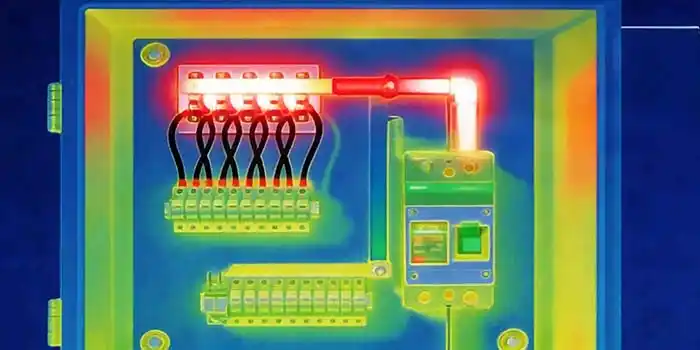
Loose connections have the same effect. Under-torqued terminals create high-resistance connections that overheat. Each additional milliohm of contact resistance at high current adds significant heat—at 150A, every extra mΩ adds about 22.5W of heat.
The heat doesn’t stay in the terminal. It conducts through the fuse end caps into the fuse body, raising the internal temperature enough to melt the fusible element at currents well below its rated value. This is a classic “nuisance blowing” scenario—the fuse blows not because of overcurrent, but because of externally generated heat.
The Touch Test
Safety first: Before touching anything in the combiner box, disconnect all DC sources, then verify that all DC voltage has discharged to 0 V before working.
Once safe:
-
Feel the fuse holders. If one position is noticeably hotter than others, you’ve found a high-resistance connection.
-
Look for discoloration. Darkened or discolored terminals, melted plastic around the fuse holder, or white/green/blue powdery deposits on contacts are all warning signs.
-
Check the wire insulation near the connection. If it’s hard or brittle for the first 1–2 cm, that indicates prolonged overheating.
-
Use a thermal camera if available. A hot spot more than 30°C above ambient on a specific fuse holder confirms the diagnosis.
The fix? Clean contact surfaces, ensure adequate contact pressure, apply dielectric grease to prevent future corrosion, and torque terminals to specification (typically around 2.5 N·m). If the holder has blown fuses three or more times, replace the entire holder—the spring clips may have lost tension.
Consider a Real Fault – When the Fuse Is Doing Its Job
Sometimes the fuse isn’t the problem. Sometimes there’s a genuine electrical fault, and the fuse is simply doing what it was designed to do: protect the system.
Signs of a True Overcurrent Event
How do you tell the difference between nuisance blowing and a real fault?
-
Immediate re-blowing: If a new fuse blows instantly or within minutes of replacement, that’s a strong indicator of a hard fault.
-
Inverter alarms: If the fuse blows at the same time the inverter reports “DC overcurrent,” “insulation resistance low,” or “ground fault,” the problem is electrical, not environmental.
-
Multiple strings affected: A single string with a fault will blow its own fuse. If multiple fuses blow simultaneously, look for a common bus fault or inverter issue.
How to Confirm
Use a multimeter or insulation resistance tester to check:
-
Open-circuit voltage of the affected string. If it’s abnormally low, there may be a module or connection issue.
-
Polarity—reverse-connected strings can cause overcurrent conditions.
-
Insulation resistance between positive and negative conductors and ground. Abnormally low resistance indicates cable damage, water ingress, or internal module short circuits.
Common real faults include:
-
DC side short circuit—a direct connection between positive and negative terminals of a module
-
Cable damage—rodents, abrasion, or UV degradation exposing conductors
-
Bypass diode failure—a failed bypass diode can create reverse current paths
-
Inverter MPPT failure—an inverter problem can draw excessive current from one or more strings
A Practical Troubleshooting Sequence
When you arrive at a site with a repeatedly blowing DC fuse, follow this sequence from simplest to most involved:
Document the Pattern
Record when the fuse blows. Is it always at the same time? Only on sunny days? Only after rain? This information is invaluable for narrowing down the cause.
Visual Inspection
Open the combiner box and inspect:
-
Fuse holder discoloration or melting
-
Loose terminal screws
-
Corrosion or moisture inside the enclosure
-
Burn marks or arcing evidence
Check for Shading Changes
Walk the array at the time the fuse typically blows. Look for new shadows from:
-
Trees that have grown since installation
-
New buildings or structures
-
Equipment added to the roof or ground
-
Bird droppings or debris accumulation
Measure String Current
With the system operating, use a DC clamp meter to measure current on each string. Compare the affected string to adjacent strings. Significant deviations point to a problem in that string.
Insulation Resistance Test
Use a megohmmeter to test insulation resistance of the affected string’s positive and negative conductors to ground. Values below 1 MΩ per 1000V of system voltage indicate a problem.
Frequently Asked Questions
Q1: Can I use a larger fuse to stop it from blowing?
You can, but you shouldn’t—not without first identifying the root cause.
Using a larger fuse masks the underlying problem. If the issue is a genuine overcurrent fault, a larger fuse may not blow in time, allowing damage to cables, connectors, or modules. If the issue is nuisance blowing from an undersized fuse, upsizing within the module’s maximum series fuse rating is acceptable. But always verify that you’re not exceeding the module’s maximum series fuse rating printed on the label.
Q2: How many times can a DC fuse blow before I need to replace the holder?
As a rule of thumb: if the same fuse position blows three or more times within a short period without an identifiable external fault, replace the entire fuse holder.
Each blowing event generates heat and mechanical stress. The spring clips can lose tension, contact surfaces can pit from arcing, and the plastic body can degrade. A damaged holder will continue to cause nuisance blowing even with correctly sized fuses.
Q3: Do all DC fuses blow at exactly their rated current?
No. Fuse operation depends on both the magnitude of overcurrent and its duration.
For gPV fuses per IEC 60269-6, the conventional non-fusing current is 1.25 × In—meaning the fuse will NOT blow at or below this current. The minimum fusing current is 1.6 × In. In practice, a fuse operating continuously at 110–120% of rated current may survive for hours before the element degrades.
This is why proper sizing matters: a modest oversizing prevents nuisance blowing from normal current fluctuations, while still providing protection against real faults.
Summary & Next Steps
A DC fuse that blows repeatedly in a solar string is never a mystery—it’s a symptom. The root cause almost always falls into one of four categories:
-
Undersized fuse – rated too close to normal operating current
-
Environmental imbalance – shading causing reverse current from healthy strings
-
Holder issues – corrosion, loose connections, or degraded contacts generating heat
-
Real electrical fault – short circuits, cable damage, or failed components
Work through them in order: start with the fuse rating, check for shading patterns, inspect the holder, and only then dig into potential faults. Most issues are found in the first three steps.