 English
 Bahasa Melayu
 Suomen kieli
 عربي
عربي  Português
 Français
 Pусский
 Español
DC Fuse vs DC Circuit Breaker: What's the Difference for Solar? | SUNTREE


In photovoltaic (PV) systems and DC power networks, overcurrent protection is non‑negotiable. DC fuses and DC circuit breakers are the two most common devices used to interrupt excessive currents and prevent damage to cables, connectors, inverters, and batteries. While they share the same ultimate goal, they differ fundamentally in how they operate, how they are maintained, and where they perform best.
This article walks you through a practical decision tree – from the basic one‑time vs. resettable distinction, to response speed, temperature sensitivity, and coordination strategies. By the end, you will know exactly which device fits your specific application, whether it is a string combiner box, an inverter input, or a battery energy storage system.
Start with the Fundamental Difference – One‑Time vs. Resettable
The most essential difference between a DC fuse and a DC circuit breaker is whether the device is sacrificial or reusable.
The DC Fuse – A Sacrificial Device
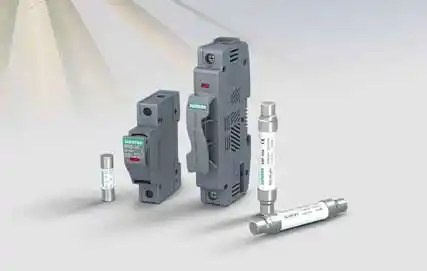
A DC fuse contains a calibrated metal wire or strip that melts when the current exceeds its rated threshold for a sufficient duration. The melting physically opens the circuit, stopping the fault current. This is a permanent, irreversible action – once the fuse has blown, it must be replaced with a new one of the same rating.
Because fuses have no moving parts, their operation is purely thermal and extremely reliable. However, every fault event incurs a replacement cost and a service visit, which is a critical factor for remote or hard‑to‑access installations.
The DC Circuit Breaker – Reusable
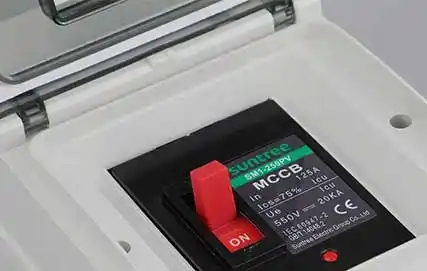
A DC circuit breaker, on the other hand, uses a mechanical switching mechanism – typically thermal‑magnetic or hydraulic‑magnetic – to trip when overcurrent is detected. After the fault is cleared, the breaker can be manually reset by flipping the toggle or pushing a button. No parts need to be replaced.
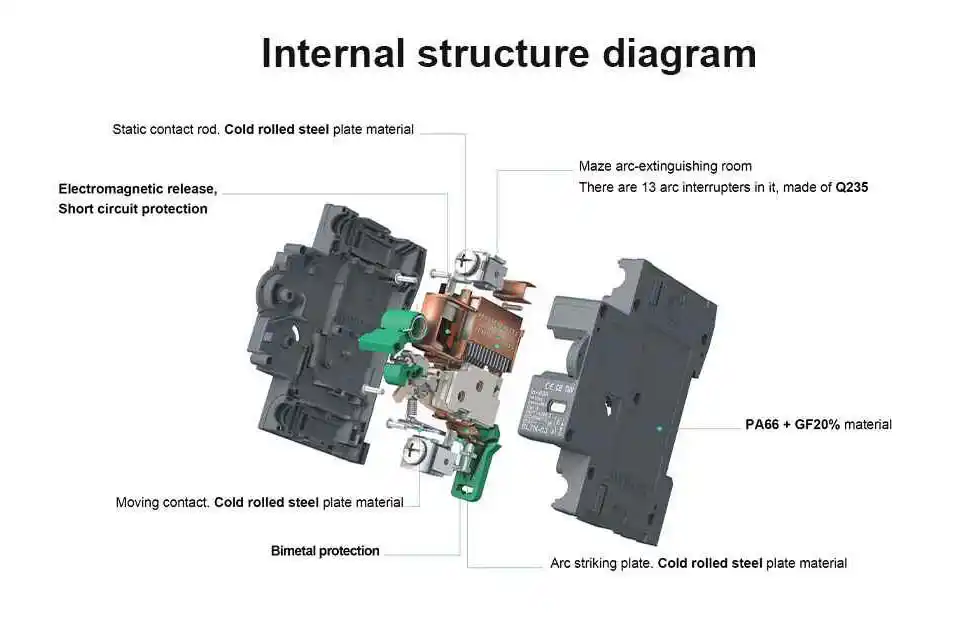
The reusable nature makes breakers more convenient for circuits that may experience occasional overloads or short‑circuits. However, the mechanical system is subject to wear over many operations, though modern designs are tested for thousands of mechanical and electrical cycles.
Look at Your Maintenance Preference – How Often Do You Expect Faults?
Your choice should heavily depend on how frequently you anticipate overcurrent events and how much downtime and maintenance you can tolerate.
When Fuses Make Sense
Fuses are often the preferred choice for circuits where faults are rare and unlikely. For example:
-
PV string outputs in well‑designed ground‑mounted solar farms, where wiring is fixed and shading is minimal.
-
Dedicated branch circuits with stable loads that seldom experience surges.
-
Applications where a low upfront cost is more important than long‑term convenience.
In these cases, the low initial cost of fuses is attractive. Even if a fuse blows once every few years, the replacement expense and effort are negligible.
When Breakers Are Better
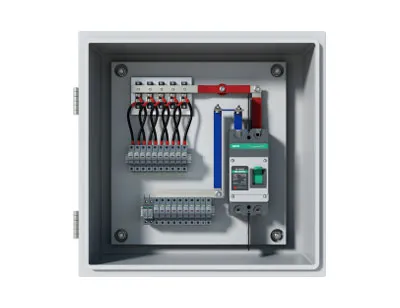
Breakers excel in circuits where frequent tripping is possible or where manual operation is required:
-
Circuits with heavy inductive loads or frequent start/stop cycles that may cause temporary overloads.
-
Equipment that requires regular isolation for maintenance – a breaker doubles as a disconnect switch.
-
Systems with high variability where nuisance trips could happen more often.
In these scenarios, the ability to simply reset the breaker avoids the hassle of stocking spare fuses, opening enclosures, and replacing elements – saving time and reducing system downtime.
Consider the Response Speed – Which Is Faster?
Both devices respond to overcurrent, but their speed characteristics differ, and this can be critical for protecting sensitive electronics.
Fuses Can Be Very Fast
Fast‑acting fuses can clear a short‑circuit current in milliseconds – often within 2- 5 ms. This rapid response is essential for protecting power semiconductors like IGBTs and diodes inside inverters, which can be destroyed by even a brief overcurrent.
Fuses have a predictable time‑current curve, and their melting time decreases sharply as fault current increases. For very high fault currents, they operate in a near‑instantaneous fashion, limiting the let‑through energy to a safe level.
Breakers Have a Slight Delay
Circuit breakers, due to the inertia of their mechanical parts and the time required for the trip mechanism to actuate, typically operate a few milliseconds slower than a fast fuse – usually in the range of 10‑30 ms for magnetic tripping, and longer for thermal overloads.
In most PV applications, this difference is negligible because cables and connectors can withstand short surges of that duration. However, for inverter DC inputs with sensitive IGBT modules, a fast fuse may still be required, sometimes in combination with a slower breaker for backup.
Compare Under High Ambient Temperature – Which Performs Better?
Temperature has a significant impact on the trip characteristics of overcurrent devices, and this is often overlooked in system design.
Fuses Are Temperature Sensitive
A fuse operates solely by thermal effect – the heat generated by current through the fuse element. As ambient temperature rises, the fuse element is already closer to its melting point, so its effective current rating derates. For example, a 15 A fuse installed on a hot rooftop may blow at 13 A or even lower, depending on the manufacturer’s derating curves.
This means you may experience nuisance blowing in hot climates, requiring you to select a higher‑rated fuse or provide additional cooling – both of which add complexity.
Hydraulic‑Magnetic Breakers Are Stable
Hydraulic‑magnetic circuit breakers use a solenoid coil and a time‑delay hydraulic dashpot to sense current. Their trip characteristics are essentially independent of ambient temperature over a wide range. The magnetic force depends only on the current, not on heat.
Thermal‑magnetic breakers, however, do have a thermal element that is temperature‑sensitive, similar to fuses. Therefore, if you expect extreme temperature variations, hydraulic‑magnetic breakers are the more stable and reliable choice. They are increasingly common in outdoor solar combiner boxes and battery enclosures.
Think About Coordination – Fuses and Breakers Together
In large DC systems, it is not always an “either/or” decision. Proper selective coordination often uses both devices in series to achieve a robust protection hierarchy.
-
Upstream fuse – acts as a backup to the downstream breaker.
-
Downstream breaker – handles routine overcurrents and serves as a local disconnect.
The idea is that the downstream breaker trips first for faults within its zone, while the upstream fuse remains intact. If the breaker fails to clear a high‑magnitude fault, the fuse will blow as a final safeguard.
Fuses generally have much higher interrupting capacities than comparably sized breakers. Therefore, in systems with very high prospective short‑circuit currents – such as large battery banks – a fuse may be placed upstream to handle extreme faults that the breaker cannot safely interrupt.
A Practical Rule of Thumb for PV Systems
Here are concrete recommendations for typical DC protection points in solar and storage installations:
1. String Combiner Boxes
Both fuses and breakers are acceptable. Fuses are cheaper and require less space per pole, so they are common in high‑string‑count combiners. Breakers are preferred when you want easy resetting without opening the box, especially if the combiner is at ground level and accessible.
2. Inverter DC Input Side
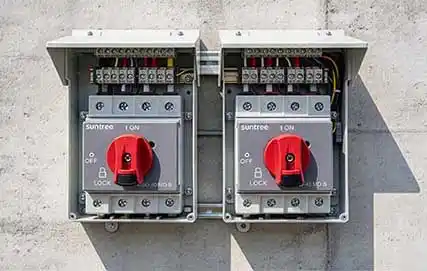
A circuit breaker is often the better choice because you typically need a manual disconnect for safe maintenance. Many inverters have integrated DC switches, but an external breaker adds redundancy and allows you to isolate the inverter without shutting down the entire array.
3. Battery Energy Storage Systems
Prioritise a high‑interrupting‑capacity breaker, and often a fuse as well. Battery faults can deliver enormous short‑circuit currents at very low voltages. Standard breakers may not be able to clear such arcs safely. A high‑rated DC breaker or a combination of fuse + breaker is strongly advised. The fuse handles extreme fault current, while the breaker provides convenient switching and overload protection.
Frequently Asked Questions (FAQ)
Q1: Can I replace a blown DC fuse with a DC circuit breaker without changing anything else?
A: Yes, provided the breaker’s rated voltage, rated current, and interrupting capacity are equal to or greater than the original fuse’s specifications. Also check the physical space – breakers are larger than fuse holders and may require a different mounting rail or enclosure depth. Always verify that the cable cross‑section and terminal connections are compatible.
Q2: Which is more reliable – a fuse or a circuit breaker?
A: Both are highly reliable when properly sized. A fuse has no moving parts and a single failure mode (blowing), so it is extremely predictable. A breaker has mechanical contacts and springs that can wear over time, but modern units are tested for thousands of operations and are equally dependable for their intended life. Reliability ultimately depends on correct application and environmental conditions.
Q3: Do I need both a fuse and a breaker in series?
A: Usually not – one device per branch is sufficient for most standard installations. However, in complex systems that require selective coordination or where the available fault current exceeds the breaker’s interrupting rating, a series combination is a well‑accepted engineering practice. The fuse acts as a backup and provides higher fault‑current withstand capability.
Summary & Next Steps
Choosing between a DC fuse and a DC circuit breaker is not about one being “better” than the other – it is about matching the device’s strengths to your system’s operational and environmental demands.
| Decision Factor | Choose a Fuse | Choose a Breaker |
|---|---|---|
| Fault frequency | Rare faults | Frequent or uncertain faults |
| Maintenance access | Easy replacement | Quick reset preferred |
| Response speed | Need ultra‑fast protection | Moderate speed acceptable |
| Temperature | Stable, mild environment | Extreme or fluctuating temperatures |
| Interrupting capacity | Very high fault currents | Moderate fault currents |
| Disconnect function | Not required | Manual isolation needed |
In the end, the decision is a trade‑off between cost, convenience, speed, and environmental robustness. Many PV projects use a hybrid approach – fuses for string‑level protection and breakers for inverter/battery disconnects – to get the best of both worlds.
Ready to make an informed choice?
Download SUNTREE’s DC Protection Device Selection Comparison Table – a handy one‑page reference with rated voltages, current ranges, temperature derating factors, and typical application recommendations for all our fuse and breaker models.
This guide is provided for informational purposes. Always consult local electrical codes and standards, and verify device specifications with the manufacturer for your specific installation.