 English
 Bahasa Melayu
 Suomen kieli
 عربي
عربي  Português
 Français
 Pусский
 Español
How to Size SPD for DC Combiner Box in Utility Solar Plants | SUNTREE


In a utility-scale solar plant, the DC combiner box serves as the central hub where multiple PV strings converge before power flows to the inverter. This makes it a critical point of vulnerability. A lightning strike or switching transient miles away can induce thousands of volts onto long DC cables, traveling directly into your expensive array.
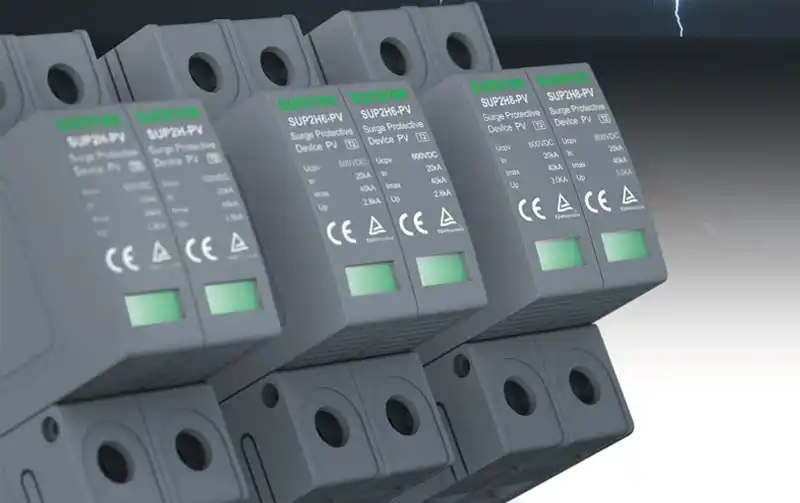
The Type 2 DC surge protection device (SPD) installed inside each combiner box is your first—and often only—line of defense. Sizing SPD for the DC combiner box incorrectly is equivalent to having no protection at all. An undersized SPD will fail silently, while an incorrectly matched one will let damaging energy pass through.
This guide breaks down the three essential electrical parameters you must get right, how to apply them to real-world solar farm conditions, and the costly mistakes to avoid.
The Three Essential Parameters of a DC SPD
Every DC SPD datasheet revolves around three core values. Together, they define whether the device will survive your system’s normal operation and whether it will protect your downstream equipment during a surge.
Maximum Continuous Operating Voltage – The Operating Window
Parameter symbol: Uc (DC)
The Maximum Continuous Operating Voltage defines the highest steady-state DC voltage the SPD can withstand without activating or degrading. Think of it as the "safe zone" boundary.
If your system’s normal voltage ever exceeds Uc—even briefly—the SPD will behave like a short circuit, overheating and failing permanently. In some cases, it may catch fire.
Why this matters in solar: PV strings do not operate at a fixed voltage. On a cold, sunny morning at high altitude, your array’s open-circuit voltage (Voc) can be 10–15% higher than the STC-rated value. Your SPD’s Uc must sit comfortably above that worst-case peak.
Nominal Discharge Current – The Reliability Indicator
Parameter symbol: In (kA)
Nominal discharge current is the peak current value that the SPD can survive multiple times without losing its protective characteristics. It is the true measure of long-term durability in the field.
A higher In means:
-
Thicker metal-oxide varistor (MOV) disks
-
Better thermal disconnector design
-
Longer service life in high-lightning regions
For utility-scale plants, In should never be less than 20kA (8/20 μs) per pole. Many EPCs now specify 40kA as a minimum for bankable projects.
Voltage Protection Level – The Clamping Threshold
Parameter symbol: Up (V)
When a surge occurs, the SPD does not eliminate the overvoltage—it clamps it down to a lower value. The Voltage Protection Level is that clamped value. Any voltage above Up will still pass through to the inverter and cables.
The critical rule: Up must be lower than the impulse withstand voltage (Uw) of the equipment you are protecting. For modern utility inverters and DC cables, Uw is typically 1.5 kV to 2.5 kV for 1500V systems. If your SPD has Up = 3.2 kV, you have essentially no protection.
How to Match Voltage Parameters to Your System
Voltage mismatch is the single most common reason SPDs fail in solar combiner boxes. Here is exactly how to get it right.
Consider the Worst-Case Open Circuit Voltage
You cannot use the nominal MPPT voltage or the standard-test-condition Voc for SPD sizing. You must calculate the maximum possible Voc at the lowest expected ambient temperature for your site.
Formula:
Vmax = Voc(STC) × [1 + (Tmin – 25°C) × Temperature coefficient of Voc]
Where the temp coefficient is typically -0.3% to -0.35%/°C (negative, meaning voltage rises as temperature drops).
Example calculation:
-
Module Voc(STC) = 50V
-
25 modules in series → 1250V at STC
-
Site minimum temperature = -10°C
-
Temperature coefficient = -0.33%/°C
-
Delta = -10 – 25 = -35°C
-
Increase = 35 × 0.0033 = 0.1155 (11.55%)
-
Worst-case Voc = 1250V × 1.1155 = 1394V
For this system, an SPD with Uc = 1500V DC would be the absolute minimum. Many engineers would step to Uc = 1600V or higher.
Leave an Adequate Safety Margin
Industry best practices (following IEC 61643-32) recommend a safety margin of at least 15–20% above your worst-case Voc.
Example:
-
Worst-case Voc = 1394V
-
Add 15% = 1603V
-
Selected Uc ≥ 1600V DC
Never size Uc exactly equal to your calculated maximum. PV strings can experience voltage doubling under certain partial shading or fault conditions, depending on the inverter topology. That extra margin is your insurance.
Selecting the Right Discharge Current Rating
KA ratings sell products, but bigger is not always smarter. Here is how to select the correct In for your site’s real risk profile.
Assessing the Site's Lightning Exposure
Start with your project’s annual isokeraunic level (thunderstorm days per year, Td). Use global lightning maps (e.g., NASA LIS, WWLLN data) or local historical records.
| Thunderstorm days (Td) | Recommended In (8/20 μs) per pole |
|---|---|
| < 20 (low risk) | 20kA |
| 20 – 50 (moderate) | 40kA |
| > 50 (high risk) | 60kA or higher |
For utility plants in Florida, India, Brazil, or Southeast Asia where Td exceeds 80, many EPCs now specify In = 40kA minimum with an option for 60kA.
Understanding the Difference Between Nominal and Maximum
This is where procurement mistakes happen frequently.
-
In (Nominal discharge current): The SPD can handle this surge level 20 times (by IEC test standards) without failing. This determines real-world lifespan.
-
Imax (Maximum discharge current): The SPD can handle this surge level once before destruction. It is a survival rating, not a working rating.
Common error: A supplier offers "40kA SPD" but the datasheet shows In = 12.5kA and Imax = 40kA. This is not a 40kA SPD for your purpose. Always ask for the In value. For utility solar, reject any SPD where In is less than half of Imax.
Type 1 vs. Type 2 SPD for DC Combiner Boxes
Many engineers mistakenly believe they need a Type 1 SPD for "heavy duty" protection. Let’s clarify.
Type 1 SPD Characteristics
-
Test waveform: 10/350 μs (simulates direct lightning strike current)
-
Application: Service entrance, buildings with an external lightning protection system (LPS), where direct strike is possible
-
Typical In: 10–25kA (10/350 μs)
-
Cost: Significantly higher
Type 2 SPD Characteristics
-
Test waveform: 8/20 μs (simulates induced surges from nearby strikes)
-
Application: Sub-distribution boards, combiner boxes, inverter DC inputs
-
Typical In: 20–80kA (8/20 μs)
-
Cost: Economical for high-volume deployment
The Correct Choice for Combiner Boxes
Your PV combiner box is almost always located in Lightning Protection Zone 1 or higher. The main DC cable from the array enters the plant, but the combiner box itself is not the building entry point. The risk is induced surges, not a direct strike.
Therefore, Select Type 2 SPD for DC combiner boxes in utility-scale solar plants.
Only consider Type 1 if the combiner box is mounted on an unshielded structure with direct strike exposure and no external LPS—an uncommon scenario in well-designed utility plants.
Common Sizing Mistakes
Even experienced engineers repeat these three errors. Avoid them to ensure your SPDs survive and protect.
Mistake 1: Ignoring Low Temperature Voltage Rise
The scenario: System designer uses 1500V modules but picks an SPD with Uc = 1500V DC exactly. First cold morning below 5-5 C, the Voc reaches 1580V. The SPD fails, taking down the entire string.
The fix: Always calculate minimum site temperature. Add 15% margin. If you cannot find an SPD with high enough Uc, reduce modules per string.
Mistake 2: Chasing IMAX While Ignoring In
The scenario: Procurement sees "100kA SPD" and approves it. In reality, In = 15kA. After two moderate lightning seasons, the SPD’s MOVs degrade, and the visual indicator shows red. Plant ops ignore it. A third surge destroys two inverters.
The fix: Make a line-item specification requirement. Reject any quotation that does not clearly state both In and Imax for the 8/20 μs waveform.
Mistake 3: Voltage Protection Level Too High
The scenario: An SPD has Uc = 1700V (good) and In = 40kA (good), but Up = 3.8 kV. Inverter DC input withstand is 2.5 kV. A 3kA surge triggers the SPD, which clamps at 3.8 kV—enough to punch through the inverter’s input capacitors.
The fix: Request Up at In (not at lower test currents). Ensure Up ≤ 0.8 × equipment withstand voltage for margin. For 1500V inverters, seek SPDs with Up ≤ 2.5 kV.
Frequently Asked Questions
Q1: Do I need an SPD for every combiner box in a large plant?
A: Yes. Every combiner box sits at the terminus of long DC string cables that act as excellent antennas for induced lightning surges. Skipping SPDs on any combiner box creates a weak link. A surge entering an unprotected box can propagate through the common DC bus and damage multiple inverters. Protect every box.
Q2: Can I use an AC SPD on the DC side of solar?
A: Absolutely not. AC SPDs are designed for sinusoidal voltage with zero-crossing points that help extinguish follow current. DC arcs have no zero-crossing. An AC SPD on a DC circuit will sustain an arc, catch fire, or explode. Always use DC-certified SPDs per IEC 61643-31 or UL 1449 (Type 4CA for PV).
Q3: How often should I replace a DC SPD after a lightning event?
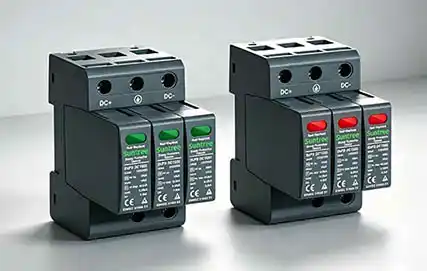
A: Check the SPD’s mechanical status indicator after every known lightning storm within 5 km of the plant. If the window is green, the SPD is operational. If it is red (or black, dependingon thee manufacturer), replace it immediately. Even without visible storms, many EPCs include SPD replacement in every 5-year major maintenance cycle, as MOVs gradually degrade from cumulative small surges.
Summary & Next Steps
Sizing SPD for the DC combiner box in a utility-scale solar plant comes down to three interdependent parameters:
-
Uc (Maximum Continuous Operating Voltage): Must exceed worst-case cold-weather Voc plus 15% margin.
-
In (Nominal Discharge Current): Your true durability rating. For utility plants, specify ≥20kA (8/20 μs), with 40kA for moderate-to-high lightning regions.
-
Up (Voltage Protection Level): Must be lower than your inverter’s impulse withstand voltage. For 1500V systems, target ≤2.5 kV.
Ignore any one of these, and your protection is compromised.