 English
 Bahasa Melayu
 Suomen kieli
 عربي
عربي  Português
 Français
 Pусский
 Español
Preventing Reverse Current Damage to DC MCCB in Battery Storage


Battery Energy Storage Systems (BESS) introduce a fundamental electrical characteristic that traditional DC power systems never had to manage: bidirectional current flow. During charging, current moves from the inverter to the battery bank. During discharging, it reverses direction, flowing from the batteries back to the inverter.
While this bidirectional capability is essential for energy storage, it creates a unique and often underestimated risk for standard DC Moulded Case Circuit Breakers (MCCBs). Conventional DC breakers are designed for unidirectional current. When subjected to reverse current, their arc extinguishing systems can fail, leading to nuisance tripping, contact welding, or complete equipment failure.
This article outlines three proven best practices to protect your DC MCCBs against reverse-current damage, ensuring reliable operation and safety in bidirectional BESS applications.
Understanding the Reverse Current Risk in BESS
Before implementing solutions, it is critical to understand why reverse current is dangerous for a standard DC MCCB.
Charging vs. Discharging – Two Opposite Directions
In a typical BESS, the power flow is not fixed:
-
Discharging mode: Current flows from the battery terminals to the inverter (load side).
-
Charging mode: Current flows from the inverter (now acting as a source) back into the battery terminals.
A standard unidirectional DC MCCB contains an asymmetric arc chute and blowout coil designed to extinguish arcs for current moving in one specific direction. When reverse current flows through that same breaker, the electromagnetic blowout coil may force the arc into the mechanism rather than the arc chute, causing catastrophic failure or fire.
High-Availability Fault Current from Battery Banks
Modern lithium-ion battery banks are low-impedance sources capable of delivering enormous short-circuit currents—often exceeding 10 kA to 50 kA at the rack level. Under normal forward current, a quality MCCB can interrupt this. However, under reverse current conditions, the same fault current can vaporise contacts instantly because the arc is not being directed into the extinguishing chamber. The combination of high fault current and wrong current direction is a recipe for contact welding.
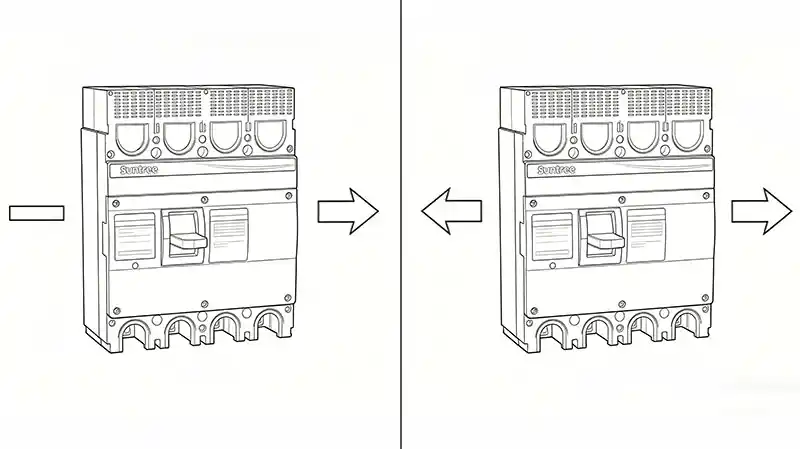
Best Practice: Use True Bidirectional DC MCCBs
The most direct and reliable solution is to select a DC MCCB that is explicitly designed for bidirectional operation. These devices are engineered to handle current flow in either direction without performance degradation.
How to Identify a Bidirectional Device
Not all breakers labelled "DC" are bidirectional. To verify a true bidirectional DC MCCB, look for the following indicators on the product label and datasheet:
-
"No Polarity" or "Bi-directional" marking: Manufacturers explicitly state this when the device is symmetrical.
-
Bidirectional arrow symbol: Look for a symbol showing two arrows pointing opposite directions (↔ or ⇄) near the terminals.
-
Same interruption rating for both directions: A genuine bidirectional breaker will list the same breaking capacity (e.g., 20 kA) for current flowing from line to load and load to line.
Symmetrical Arc Extinguishing Design
Internally, a bidirectional DC MCCB features a fully symmetrical arc extinguishing chamber. The key design elements include: Centred
-
d arc runners: Both sides of the moving contact have identical arc runners.
-
Dual blowout coils (or none): Instead of a single electromagnetic coil that only functions in one direction, bidirectional designs use permanent magnets or symmetrical coils that work regardless of current vector.
-
Identical contact geometry: The fixed and moving contacts are designed to open with the same arc stretching distance in both directions.
This symmetrical construction ensures that the arc is always drawn into the arc chute—never back into the operating mechanism—whether the system is charging or discharging.
Best Practice: Coordinate with BMS for Directional Sensing
Even with a bidirectional MCCB, the breaker alone cannot "know" when a fault is directional in nature. The Battery Management System (BMS) possesses real-time current direction data. Integrating this intelligence with your MCCB creates a smarter protection layer.
Using BMS Current Direction Data
Modern BMS units monitor current with Hall-effect sensors or shunt resistors, providing precise data on both magnitude and direction. To leverage this:
-
Connect the BMS current direction output to a shunt trip accessory on the DC MCCB.
-
Program the BMS logic to trigger a shunt trip command if it detects sustained reverse current exceeding a safe threshold (e.g., longer than 100 ms during expected charging periods).
-
This acts as a supervisory protection layer—the MCCB still handles high short-circuits thermally/ magnetically, but the BMS can preemptively open the breaker for lower-level reverse current faults.
Setting Protection Thresholds
Bidirectional systems allow for asymmetric protection profiles. Because charging is typically a more controlled process than discharging, you can optimise thresholds:
-
Charging direction (inverter → battery): Set a tighter overcurrent protection threshold. For example, 110% of the nominal charge current for 5 seconds. This protects sensitive battery cells from overcharge current.
-
Discharging direction (battery → inverter): Set a slightly higher or slower threshold (e.g., 125% for 10 seconds) to avoid nuisance tripping during load startup transients.
This directional selectivity is impossible with a standalone breaker and requires BMS coordination.
Best Practice: Regular Inspection with Charge/Discharge Cycles
Passive protection is not enough. Active maintenance that respects the bidirectional nature of BESS is essential. Standard thermal imaging during discharge only tells half the story.
Thermal Imaging Under Both Conditions
Perform thermal imaging surveys twice per maintenance cycle:
-
At full-power discharge (battery → inverter): Observe terminal temperatures on the battery side and inverter side.
-
At full-power charge (inverter → battery): Repeat the scan immediately after reversing flow.
What to look for: If a terminal or internal connection point shows significant temperature rise only during discharge but not during charge (or vice versa), this indicates internal contact asymmetry or partial welding. A properly functioning bidirectional MCCB should show nearly identical thermal patterns in both directions. A delta of more than 10°C between the two conditions warrants breaker replacement.
Visual Inspection of Terminal Markings
Over time, repeated thermal cycling loosens terminal bolts and fades polarity markings. Every six months:
-
Verify terminal markings are legible. If “LINE” and “LOAD” markings (if present on a bidirectional device—many have none) are worn, relabel with weather-resistant vinyl or UV-stable cable tags.
-
Torque check all connections to the manufacturer’s specification (typically 2–4 Nm for 100A frames). Loose terminals increase resistance and mimic polarity-related failures.
A Typical Protection Scheme for a Battery Rack
To illustrate these practices in action, consider a typical 48V nominal battery rack used in a commercial BESS:
Scenario: A rack with 100Ah lithium batteries, maximum operating current of 100A (charge or discharge). The available short-circuit current from the rack is 15 kA.
Recommended protection scheme:
-
Select a bidirectional DC MCCB with rating: 125A frame, 20 kA breaking capacity (provides 25% headroom above 100A operating current).
-
Mounting location: Within 150 mm (6 inches) of the battery positive terminal. This minimises unprotected cable length between the battery and the breaker.
-
Auxiliary protection: Install a 150A fast-acting NH-style fuse upstream (battery side) as backup protection for fault currents exceeding the MCCB’s rating. Coordinate the BMS to signal the MCCB’s shunt trip for any reverse current >120A lasting >2 seconds during scheduled charge periods.
This scheme provides three layers: primary overcurrent (MCCB), backup fusing, and BMS-driven directional supervision.
Frequently Asked Questions (FAQ)
Q1: Can I use two unidirectional DC MCCBs back-to-back to simulate bidirectional protection?
A: Technically possible but not recommended in practice. You would need two breakers wired in series with opposite polarity, plus an interlock to ensure only one closes at a time. This doubles the cost, requires double the panel space, introduces potential race conditions if both close simultaneously, and creates a higher voltage drop. A single bidirectional MCCB is simpler, more reliable, and often cheaper overall.
Q2: Does a DC MCCB protect against both overcurrent and reverse current?
A: No. A standard DC MCCB protects against overcurrent in its rated direction. It does not inherently protect against reverse current. Reverse current protection requires either:
-
A bidirectional MCCB, or an external detection system, to open the breaker when reverse current is detected.
Q3: What is the typical lifespan of a bidirectional DC MCCB in a daily cycling BESS?
A: For a quality bidirectional MCCB under one full charge/discharge cycle per day (365 cycles/year):
-
Mechanical life: 6,000 to 10,000 operations.
-
Electrical life under rated load: 1,500 to 3,000 operations, as each operation causes some contact wear.
-
Recommended replacement interval: 5–7 years for critical applications, or sooner if thermal imaging shows asymmetry or if the breaker has interrupted a major short-circuit fault.
Summary & Next Steps
Reverse current damage to DC MCCBs is a predictable and preventable failure mode in battery storage systems. By implementing three core practices, you can eliminate this risk:
-
Specify true bidirectional DC MCCBs with symmetrical arc extinguishing chambers—never assume a standard DC breaker will work in both directions.
-
Coordinate with the BMS to use current direction data for intelligent shunt trip triggering and asymmetric protection thresholds.
-
Inspect under both charge and discharge conditions using thermal imaging, and relabel terminals every six months.
Bidirectional power flow is the essence of energy storage. Your protection devices must match that bidirectional reality.
Ready to retrofit or design a more reliable BESS? Contact SUNTREE today to request engineering samples of our dedicated bidirectional DC MCCB series, purpose-built for battery racks, PCS cabinets, and microgrid applications.
Note: The images within this article are for reference purposes only. For detailed information, please contact Suntree.