 English
 Bahasa Melayu
 Suomen kieli
 عربي
عربي  Português
 Français
 Pусский
 Español
How to Select the Right DC MCB Rating for Solar Strings


How to Select the Right DC MCB Rating for Your Solar String Current
- The problem: Wrong DC MCB selection causes nuisance tripping, equipment damage, and even fire hazards.
- The solution: A practical, standard-backed framework to size DC miniature circuit breakers (MCBs) for photovoltaic strings — based on NEC 690.9, temperature derating, and real-world field experience.
Selecting the correct DC MCB rating for solar strings is not a “one-size-fits-all” decision. Installers and system designers often struggle between oversizing (which reduces protection) and undersizing (frequent nuisance trips). This guide walks you through every parameter — from solar string current calculation to temperature derating factor — ensuring your PV system remains safe, code-compliant, and reliable for decades.
Understanding the Three Core Parameters of a DC MCB
Before diving into selection steps, you must understand three critical ratings that define any DC miniature circuit breaker.
Rated Current – The Continuous Load Limit
Rated current (In) is the maximum continuous current a DC MCB can carry without tripping under specified conditions. For solar strings, this value must be higher than the maximum power current (Impp) of your PV array. If the operating current persistently exceeds the rated current, the bimetallic strip inside the MCB heats up and trips — causing unwanted downtime.
Rated Voltage – The Arc Quenching Capability
DC arcs do not self-extinguish like AC arcs (which have zero-crossing points 50/60 times per second). A DC MCB’s rated voltage must be higher than the maximum system voltage, especially considering cold-weather voltage rise. Using a 250V DC breaker on a 300V string invites catastrophic arc failure. Always check the datasheet for DC voltage rating — typically 250V, 500V, 1000V, or 1500V for utility-scale.
Breaking Capacity – The Fault Current Safety Net
Breaking capacity (Icu or Ics) is the maximum fault current the MCB can interrupt without welding contacts or exploding. For residential strings, 6kA to 10kA is often sufficient. For commercial rooftop or battery-coupled systems, fault currents can exceed 15kA. Rule of thumb: calculate prospective short-circuit current at the combiner box and select an MCB with breaking capacity ≥ that value.
A Practical Step-by-Step Selection Process
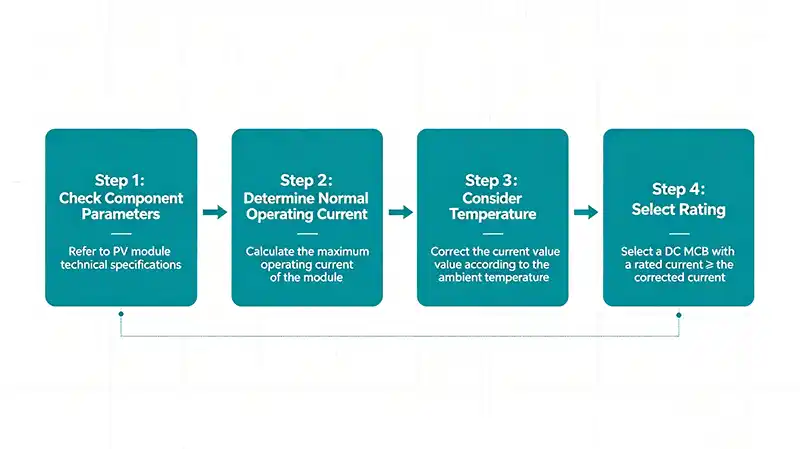
Follow this structured method to determine the correct DC MCB rating selection for solar applications. We integrate NEC 690.9 guidelines and temperature derating best practices.
Step 1: Determine the Normal Operating Current of Your String
Open the PV module datasheet. Find IMPP (current at maximum power point). For a single string, multiply this by the number of parallel strings. Example: If one module has IMPP = 9.8A, and you have 2 strings in parallel, the total string current = 19.6A. That’s your baseline.
Step 2: Apply the Industry Safety Margin (125% Rule)
NEC 690.9(B) requires overcurrent protection devices to be sized at 125% of the maximum circuit current for continuous duty (3+ hours). For solar PV, strings are considered continuous sources. Formula: MCB minimum rating = Istring × 1.25. Using the example above: 19.6A × 1.3 = 25.48A → choose the next standard size: 25A or 32A, depending on availability.
Step 3: Adjust for High Temperature Conditions
High ambient temperatures (rooftop, desert, metal enclosures) reduce the MCB’s current-carrying capacity. Most DC MCBs are calibrated for 40°C ambient. For every 10°C above 40°C, derate by roughly 10–15%. The temperature derating factor should be applied as: Adjusted rating = desired load / derating factor. Example: required 25A at 60°C ambient, derating factor = 0.85 → 25A / 0.85 ≈ 29.4A → choose 32A MCB. Always refer to the manufacturer’s derating curves.
Matching Voltage Ratings to Your System
Voltage mismatch is a common hidden killer. DC MCBs rely on arc chutes designed for specific voltage levels. Exceeding the rated voltage leads to sustained arcing and fire.
Accounting for Cold Weather Voltage Rise
PV modules produce higher open-circuit voltage (Voc) at lower temperatures. Use the temperature coefficient of Voc (provided by the module manufacturer) and the record low temperature at the installation site. Formula: Vmax = Voc × [1 + (25°C - Tmin) × αVoc]. Example: Voc = 50V, αVoc = -0.3%/°C, Tmin = -10°C → voltage rise ≈ 5.25% → Vmax ≈ 52.6V per module. For 10 modules in series → 526V → select 600V or 1000V DC MCB.
Series vs. Parallel Strings
- Series connection: Voltages add, current stays the same → choose MCB with voltage rating above total Voc (cold temp).
- Parallel connection: Currents add, voltage stays the same → ensure MCB current rating covers the sum of parallel currents with a 1.25 safety factor.
For non-grounded systems, NEC recommends a 2-pole DC MCB that disconnects both positive and negative poles simultaneously, eliminating any potential floating voltage hazards.
Common Selection Mistakes to Avoid
- Using AC-rated breakers for DC circuits: AC MCBs rely on the zero-crossing of alternating current to extinguish arcs. On DC, the arc persists continuously and will not self-extinguish, leading to contact welding and fire. Never substitute.
- Ignoring breaking capacity (Icn): Even if the rated current and voltage are correct, a low breaking capacity (e.g., 3kA) on a high-fault string (e.g., 8kA short-circuit current) will cause the MCB to explode or fail to clear the fault. Always compute the maximum prospective short-circuit current from the battery or array.
- Neglecting temperature derating: Many field tripping issues in summer occur because the installer sized the MCB at 1.25× IMPP but ignored a 55°C rooftop environment. The MCB trips prematurely because its internal thermal element responds to both load current and ambient heat.
Selection Recommendations by System Type
| System Type | Typical DC MCB Rating (example) | Key Considerations |
|---|---|---|
| Small residential string (1–5 kW) | 10A – 25A / 250V or 500V | Compact 1-pole or 2-pole; breaking capacity 6kA is enough for most. Prefer 2-pole for full isolation. |
| Commercial rooftop (20–100 kW) | 32A – 63A / 1000V DC | Higher breaking capacity (10kA+); use 2-pole per string. Consider selective coordination with upstream breakers. |
| Large ground-mount & utility | Custom (63A – 125A+) / 1500V DC | Selectivity study required; high breaking capacity ≥ 15kA; electronic trip units optional but recommended. |
Frequently Asked Questions (FAQ)
- Q1: Can I use an AC MCB for a DC circuit?No, never. AC breakers lack proper arc-extinguishing chambers for DC. The DC arc does not have a zero crossing and will continue to burn, potentially melting the breaker and starting a fire. Always use a dedicated DC MCB certified to IEC 60947-2 or UL 489 for DC.
- Q2: What is the difference between a 1-pole and 2-pole DC MCB?A 1-pole DC MCB switches only one conductor (typically positive or negative). A 2-pole DC MCB simultaneously disconnects both positive and negative poles. For ungrounded PV systems (common in modern residential/commercial), NEC 690.13 recommends a 2-pole disconnection to ensure complete isolation, enhancing safety during maintenance.
- Q3: How often should I test my DC MCBs?Perform a manual mechanical test (push the test button or toggle the lever) annually to ensure free movement. For trip characteristic verification (thermal and magnetic), hire a qualified electrician every 3–5 years. In harsh environments (dust, salt, high humidity), shorten the interval to 2 years.
- Q4: What is the 1.25 factor in NEC 690.9?NEC 690.9(A) requires overcurrent protection for PV source and output circuits to be sized at 125% of the maximum currents to account for continuous operation. This factor ensures the MCB does not trip under normal full-sun conditions.
Summary & Next Steps
Correct DC MCB rating selection for solar boils down to three pillars: rated current (with 125% margin + temperature derating), rated voltage (accounting for cold weather rise), and breaking capacity (sufficient for worst-case fault). Skipping any of these compromises safety and reliability. Always verify that the breaker is specifically designed for DC PV applications and complies with IEC/UL standards.
Before buying, run a quick solar string current calculation, including all parallel strings, then apply the NEC 1.25 multiplier and local temperature derating factor. Match the MCB’s voltage rating to the maximum cold-weather Voc of the series string. Finally, confirm that the breaking capacity exceeds the prospective short-circuit current at the installation point.