 English
 Bahasa Melayu
 Suomen kieli
 عربي
عربي  Português
 Français
 Pусский
 Español
How to Prevent DC Arc Fault in Panel Level Rapid Shutdown Switches


DC arc faults are among the most dangerous and least understood hazards in photovoltaic (PV) systems. Unlike AC arcs, DC arcs have no natural zero-crossing point, meaning once initiated, they can sustain themselves indefinitely, generating temperatures exceeding 3,000°C. This extreme heat is a primary ignition source for PV fires.
Panel-level rapid shutdown switches have become mandatory on many rooftops to comply with safety standards like NEC 2023. While these devices significantly reduce shock hazards for firefighters, they introduce new potential failure points where DC arc faults can originate. A standard RSD is not inherently an arc extinguisher.
This article provides practical, engineering-driven solutions to prevent DC arc fault occurrences in panel-level rapid shutdown switches, covering installation best practices, advanced device selection, and proactive maintenance strategies.
Understanding Arc Faults in RSDs
Before implementing prevention measures, it is critical to distinguish between the two primary types of DC arcs that can occur inside or at the terminals of a rapid shutdown switch.
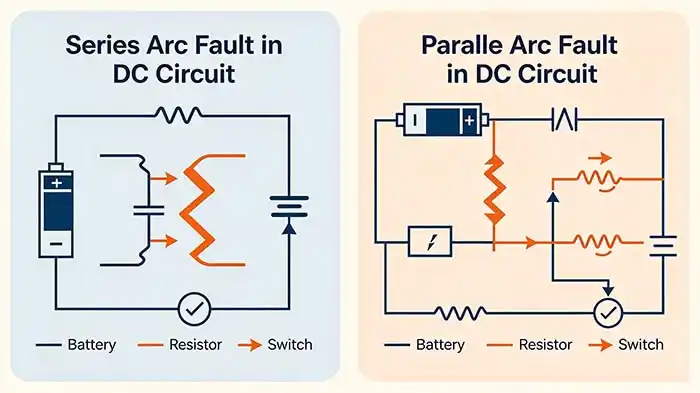
Series Arc Fault – The Loose Connection Hazard
A series arc fault occurs along the main current-carrying path. Inside an RSD, this typically happens when:
-
A terminal screw is tightened below the minimum torque specification.
-
Contact surfaces oxidize due to moisture ingress.
-
Vibration over time loosens a connection.
In this scenario, the arc appears in series with the load. The total circuit current does not exceed normal operating levels, making series arcs nearly invisible to standard overcurrent protection devices like fuses or breakers. However, the localized heat at the loose contact point can melt the RSD housing and ignite nearby roofing materials.
Parallel Arc Fault – The Insulation Breakdown
A parallel arc fault happens between conductors of opposite polarity or between a conductor and ground. Within an RSD, this can result from:
-
Deteriorated insulation due to UV exposure or aging.
-
Conductive dust is accumulating across terminals.
-
Water condensation forms inside a poorly sealed enclosure.
Parallel arcs typically draw high currents, often triggering overcurrent devices. However, if the impedance is high enough, a parallel arc can sustain without tripping a breaker, continuing to release enormous heat until catastrophic failure occurs.
Prevention Solution 1 – Proper Torque During Installation
The majority of RSD-related arc faults trace back to improper termination during installation. This is entirely preventable with disciplined practices.
Follow Manufacturer Torque Specifications
Every panel-level RSD has a specified torque range for its DC input and output terminals, typically between 1.0 N·m and 1.7 N·m (9-15 in-lbs) for common field-wirable connectors. Do not rely on "feel" or manual screwdrivers.
-
Use a calibrated torque screwdriver or torque wrench for every single termination.
-
Verify the tool’s calibration date is current.
-
Tighten to the middle of the specified range to allow for thermal expansion.
A terminal that is under-torqued will have high contact resistance, generating heat and initiating a series arc fault over time. Over-torquing can strip threads or crack the terminal block, creating an equally dangerous situation.
Re-torque After Thermal Cycling
PV systems experience daily thermal cycles: hot in direct sun, cool at night. These cycles cause expansion and contraction of copper wires and aluminum terminals, which can loosen screws by 15–20% within the first few months.
Best practice: Return to the site approximately 3 months after initial commissioning. With the system de-energized (DC disconnect open), re-torque every RSD terminal to the original specification. Document this step in your maintenance log.
Prevention Solution 2 – Use Arc Fault Detection Integrated RSDs
Traditional RSDs are passive—they simply wait for a shutoff signal. They do not monitor arc activity. The most effective prevention is to replace these with arc-fault detection integrated RSDs that actively identify and interrupt arcs.
How Arc Fault Detection Works
An RSD with integrated arc fault detection (AFD) continuously samples the high-frequency current waveform on the DC circuit. A normal DC has a relatively flat noise floor. A DC arc fault generates distinct high-frequency signatures with random amplitude modulation.
The AFD algorithm:
-
Monitors for these characteristic high-frequency noise patterns.
-
Uses time-domain and frequency-domain analysis to distinguish actual arcs from "nuisance" sources.
-
Upon positive arc identification, it triggers the RSD’s internal switch to open within milliseconds, extinguishing the arc by removing current flow.
Benefits of Panel-Level Detection
String-level AFCI can tell you that an arc exists somewhere in a 600V string of 15+ modules, but not which one. Panel-level detection pinpoints the exact module and RSD where the arc occurred. This dramatically reduces troubleshooting time and eliminates the need for sequential disconnection testing.
For commercial installations, this feature alone can save days of labor when diagnosing an intermittent arc fault.
Prevention Solution 3 – Regular Thermal Imaging Inspections
Not all arc faults announce themselves audibly or visibly. Many begin as high-resistance connections that generate heat long before a sustained arc develops. Thermal imaging is the most effective non-invasive method to catch these precursors.
What to Look For
Using a thermal imaging camera with sufficient resolution, scan every RSD in the system. Pay special attention to:
-
Terminal entry points: Wires should be near ambient temperature.
-
The RSD body: Compare temperature to identical devices under similar solar irradiance.
-
Wire insulation: Discoloration or melting indicates past overheating.
Red flag: Any RSD showing a temperature rise of 20°C or more above the ambient temperature, or more than 10°C above neighboring RSDs under identical load conditions. This strongly indicates internal contact degradation or an incipient arc fault.
Inspection Frequency Recommendations
-
New systems: Perform the first thermal scan after 3 months of operation. This captures initial settling issues and torque relaxation.
-
Ongoing maintenance: Every 6–12 months thereafter.
-
Harsh environments: Increase frequency for high-dust or high-humidity locations to every 3–4 months.
Document all thermal images with time stamps and irradiance conditions for trend analysis.
Prevention Solution 4 – Keep RSDs Clean and Dry
Environmental factors are a leading cause of parallel arc faults inside RSD enclosures. Moisture and conductive contamination lower the insulation resistance between live parts until a flashover occurs.
Sealing and Enclosure Integrity
Modern panel-level RSDs are typically rated IP67 or IP68. However, this rating is only valid if the enclosure is intact and properly closed.
-
Before installation: Inspect every RSD for hairline cracks in the plastic housing. Reject any with visible damage.
-
During installation: Verify that all sealing gaskets are seated correctly and that conduit entries have proper sealing washers or potting.
-
Post-installation: Water ingress often occurs through cracked conduit bodies or poorly sealed junction boxes upstream, with water then traveling via capillary action into RSDs. Inspect upstream enclosures as well.
If an RSD shows signs of internal condensation, replace it immediately. Drying it out is not sufficient, as contaminants dissolved in the water will remain on internal surfaces, promoting future arcing.
Cleaning Schedule for Dusty Environments
Not all dust is conductive, but many are. Carbon dust from nearby traffic or industrial processes, cement dust, and metal grinding particles can all create a conductive path on the surface of an RSD’s terminal block.
-
Desert or agricultural areas: Fine sand is generally not conductive but can trap moisture against the housing. Wipe RSD exteriors quarterly with a dry cloth.
-
Industrial zones: Use an insulation resistance tester annually to check from positive to negative and from each terminal to ground. Replace any RSD showing insulation resistance below 1 MΩ.
Frequently Asked Questions (FAQ)
Q1: Can a rapid shutdown switch prevent an arc fault?
A standard RSD cannot prevent or extinguish an arc fault. It is a simple switch. However, an RSD with integrated arc fault detection (AFD) can detect an arc and open the circuit within milliseconds, effectively interrupting the arc. Without AFD, the RSD will continue passing current through an arc until the fault is manually cleared.
Q2: What is the difference between a series and a parallel arc fault?
A series arc fault occurs along a single conductor (e.g., a loose terminal). Current is equal to or less than the normal operating current. A parallel arc fault occurs between conductors of opposite polarity or to ground. Parallel arcs typically draw higher current but can still sustain without tripping a breaker if the path impedance is high. Both are dangerous, but series arcs are harder to detect because the current does not rise.
Q3: Does NEC require arc fault protection for PV systems?
NEC 2023 requires arc fault circuit interruption (AFCI) for all DC PV systems on buildings with voltages of 80V or more. The requirement applies to circuits that are not solidly grounded. However, NEC does not explicitly require panel-level AFCI; string-level AFCI is common. Adding panel-level AFCI via integrated RSDs provides superior fault localization and may help meet future code updates.
Summary & Next Steps
Preventing DC arc faults in panel-level rapid shutdown switches is not a single action but a layered strategy. It begins with meticulous installation—using torque tools and re-torquing after thermal cycling. It continues with intelligent equipment selection, choosing RSDs that integrate arc fault detection for active protection. Finally, it requires ongoing vigilance through thermal imaging and environmental controls.
For safety engineers and system designers, the message is clear: treat RSDs not as fit-and-forget components, but as active safety devices that demand quality installation and regular monitoring.
Next step: Evaluate your current RSD specification. Does it include integrated arc fault detection? If not, consider upgrading to a solution that does.
Explore SUNTREE’s AFD-integrated rapid shutdown solutions — designed for panel-level arc detection, automatic fault interruption, and NEC 2023 compliance. [Internal Link to Product Category Page]
Note: The images in this article are for reference only.