 English
 Bahasa Melayu
 Suomen kieli
 عربي
 Português
 Français
 Pусский
 Español

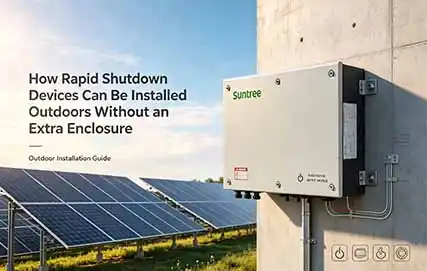
How Rapid Shutdown Devices Can Be Installed Outdoors Without an Extra Enclosure


On rooftop projects, one question surfaces again and again during layout and procurement: Does the rapid shutdown device itself have to go inside a box, or can it live outdoors directly? The honest answer is not a blanket “yes” or “no.” It depends on which rapid shutdown device you are dealing with—a module-level RSD or a transmitter—and on what “outdoors” actually looks like at the mounting point. An RSD rated IP68 or NEMA 6P is built to survive weather, but that rating does not automatically mean the manufacturer wants it baking in direct sun or sitting in a puddle of standing water. Understanding that distinction is what separates a compliant, durable outdoor installation from one that passes inspection and then fails in year three.
Start with the Device’s Rated Installation Environment
The first checkpoint is the product datasheet, not the installer’s intuition. A rapid shutdown device carries an enclosure rating—typically NEMA 3R, NEMA 4, NEMA 4X, NEMA 6P, or an IP equivalent such as IP65 or IP68. These ratings describe the device’s ability to resist rain, dust, and in some cases, prolonged immersion. The SUNTREE Rapid Shutdown Device line, for example, includes models with IP66 aluminium enclosures and over-temperature protection at 85°C, positioned for direct outdoor service on PV arrays.
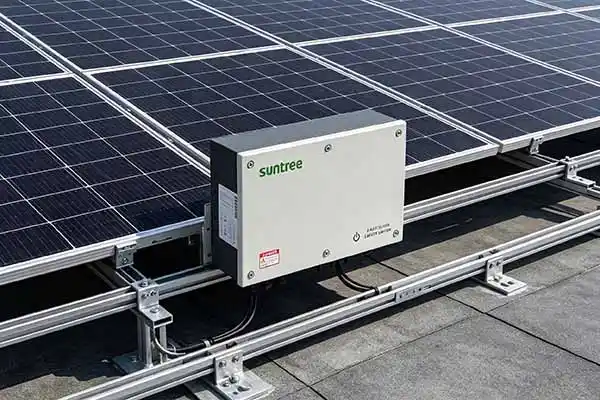
But the enclosure rating is only one line in the specification table. Equally important is the working temperature range. Many RSDs are rated to operate up to 70°C or 80°C ambient, but rooftop microclimates can push the local temperature around the device well beyond the ambient weather forecast. SolarEdge’s derating documentation, for instance, shows some power optimizers operating at full rating only up to 70°C (158°F), with reduced ratings permitted up to 85°C. That is the device’s internal protection working as designed—but it also signals that heat is a real constraint, not a theoretical one.
The third piece is the manufacturer installation documentation. This is where the practical answer usually lives. A product can be “outdoor rated” and still carry an explicit instruction such as: “Do not place the RSD where exposed to the sun, rain or snow, even in the gap between modules.” The rating says the enclosure can take it; the installation instruction says the manufacturer does not want it fully exposed. Both are true at the same time, and the installer has to reconcile them through mounting location.
Outdoor Exposure Means More Than Rain
Treating “outdoor” as a synonym for “gets wet” misses most of the degradation mechanisms that affect rooftop electronics.
UV Exposure
Solar modules are designed to face the sun. An RSD clipped to the module frame or racking shares that exposure. Polymer seals, connector housings, and cable jackets all age under continuous ultraviolet light. Even when the device body is UV-stabilized, the DC connectors and cable entries are often the first points of embrittlement. The connector interface—not the box—is frequently the weak link.
Rooftop Heat
The surface temperature of a dark rooftop under full sun can exceed the air temperature by 20–30°C or more. The gap between the module backsheet and the roof is a particularly harsh microclimate: it is shaded from wind but still heated by the module above and the roof below. Manufacturers account for this by specifying minimum clearances. SUNTREE’s NEC 2026 panel-level RSD install guide specifies a minimum 12.7 mm (½ in) between the RSD and any module glass or backsheet, and instructs installers to keep the device clear of the module’s backside ventilation area so cooling airflow is not blocked. A box added later can shrink that clearance, not improve it.
Dust and Moisture
Dust accumulation on a horizontally oriented surface creates a moisture trap. When morning dew or a passing shower wets the dust layer, the resulting paste can hold water against seals and connector interfaces far longer than a clean surface would. An RSD mounted in a position where it can shed water—rather than collect it—outperforms the same device mounted flat or in a recess.
Temperature Cycling
Every sunrise and sunset, every passing cloud, and every bypass event produces a thermal cycle. Solder joints, wire bonds, and connector contacts fatigue over thousands of cycles. A device running closer to its thermal limit accelerates that fatigue. The takeaway is not that outdoor RSDs fail—they are designed for this service—but that mounting location is a thermal design decision, not merely a mechanical one.
Where the RSD Is Mounted Changes the Environment
The phrase “installed outdoors” covers a wide range of microclimates. The same device can see dramatically different conditions depending on where it sits.
Module Support Structure
Clamping or clipping the RSD to the module frame or racking is the standard module-level approach. It keeps wiring runs short and places the device inside the array boundary. The constraint is clearance: the device must not sit flush against the frame or the module backsheet. SUNTREE’s install guide echoes the 12.7 mm backsheet clearance requirement and adds that the device must not be left hanging or suspended only by its cables. The structure mounting method works when that gap is maintained and the device is oriented so water drains away.
Wall Mounting
A vertical wall surface—whether on a parapet, a mechanical screen, or the side of a rooftop access structure—is often more forgiving than a horizontal roof plane. Water sheds readily, convective airflow is better than in the module gap, and the surface may receive less direct irradiance depending on orientation. The limitation is voltage-drop and cable routing: moving the RSD to a wall may lengthen DC conductors and require additional strain relief. For transmitters and other non-module-level equipment, wall mounting inside a rated enclosure is common, but the enclosure itself must still be placed out of direct sun where possible.
Under-Module Location
The space beneath a module is shaded from direct sun but heated by the module above. It is not a cool environment. SUNTREE’s installation guide explicitly advises installers to avoid areas exposed to direct sunlight, rain, snow, or excessive dust, which means the under-module zone is not automatically a protected location. Under-module mounting can work, but only with verified clearance and airflow—not as an assumption that “under the panel” equals “protected.”
Open Roof Position
A fully exposed position on open racking or a ballasted roof plane offers the best airflow and the worst UV and rain exposure. Module-level RSDs are sometimes mounted here in commercial layouts, but SUNTREE’s guide places this scenario in the “avoid” column for direct exposure. If the installation manual says not to leave the device exposed to sun, rain, or snow, an open roof position is exactly the condition that instruction prohibits. In that case, the outdoor-rated device still needs a location that provides some shielding—or a different mounting strategy.
The Connectors Around the RSD Need Equal Attention
A device body can meet NEMA 6P and still fail at the connector. The mated pair—RSD output connector to string cable, or RSD input connector to module lead—is an environmental seal only when fully engaged and correctly mated. Unused ports must be capped with the manufacturer’s sealing caps, not left open. Connector brands should not be mixed unless the manufacturer explicitly permits it. In practice, the outdoor rating of the RSD is only as good as the sealing of every mated connector in the string.
The broader product family around the RSD reflects the same principle. The PV Array Level Firefighter Safety Switch is offered in 1–2 string configurations with shutdown feedback and auto-shutdown above 70°C, and its installation instructions presume the same attention to cable entry, connector sealing, and thermal clearance as a module-level RSD. A device that is rated for outdoor use still depends on the integrity of every interface around it.
Can an Extra Enclosure Create Other Problems?
The reflex to add a weatherproof box “for protection” can introduce as many problems as it solves.
Heat accumulation is the most immediate. A sealed enclosure around a device that already dissipates heat adds a thermal resistance layer. If the RSD is operating near its derating threshold on a hot roof, an enclosure can push it over that threshold. SUNTREE’s RSD models already carry internal over-temperature protection at 85°C, which illustrates that the device is thermally managed as a standalone outdoor unit—adding an unventilated box removes margin rather than adding it.
Service difficulty is the second cost. A box that is screwed shut, sealed with gasket, and mounted under modules may be effectively inaccessible for inspection or replacement without removing modules. What looked like protection at commissioning becomes a maintenance obstacle later.
Cable bending and strain often worsen inside small enclosures. A compact box can force tighter bends than the cable is rated for, especially when multiple string conductors are dressed into the same enclosure.
Additional splice points are introduced whenever a device is enclosed and re-terminated. Each additional mated connector pair is another potential moisture ingress point and another connection to torque and inspect. The net reliability effect of adding a box is not automatically positive.
Why Future Service Access Should Be Planned During Installation
An RSD is a safety device, and safety devices need to be verifiable. The time to decide how a technician will reach the RSD for a function test, a connector inspection, or a replacement is during layout—not after the array is closed. SUNTREE’s comprehensive service model covers project consultation, product customization, and aftersales support, and those service pathways assume that the installed device can actually be reached, inspected, and replaced when needed.
A module-level RSD clipped to the upper frame of a portrait-oriented module may be reachable from the eave; the same device on the lower frame of a landscape module near the ridge may not be. SUNTREE’s install guide recommends installing on the perimeter of the array where possible for easier future servicing. Under-module positions that require module removal for access should be reserved for devices with demonstrated long-term reliability and a realistic plan for array disassembly. Planning service access and planning thermal clearance are closely related tasks: both depend on leaving space around the device rather than burying it.
Frequently Asked Questions
Does an outdoor RSD always need another waterproof box?
No. A module-level RSD with an appropriate outdoor enclosure rating—such as IP66, NEMA 6P/IP68, or NEMA 3R/IP68—is designed to be installed in outdoor environments without an additional box, provided the manufacturer’s mounting location and clearance instructions are followed. SUNTREE’s RSD product line, for example, is built around IP66 aluminium enclosures intended for direct mounting near PV modules. The critical qualifier is where outdoors: an exposed position that violates the manufacturer’s “avoid direct sunlight, rain, snow” instruction is not made acceptable by the device’s rating.
Can an RSD be mounted under a solar panel?
Yes, under-module mounting is a common configuration, but it is a thermal environment, not a protected one. SUNTREE’s install guide requires a minimum 12.7 mm between the RSD and the module backsheet and keeps the device clear of the module’s ventilation area, precisely because the under-module gap can be hotter than open air. The clearance and airflow provisions in the installation manual are functional requirements, not suggestions.
Does rooftop heat affect rapid shutdown reliability?
Yes. Rooftop heat accelerates thermal cycling and can push an RSD into a derated or protective state. SUNTREE’s RSD includes over-temperature protection at 85°C, and the PV Array Level Firefighter Safety Switch features auto-shutdown above 70°C—both are protective responses to heat that is already present in the rooftop environment. The practical implication for outdoor installation is that mounting location determines the thermal load, and a position with poor airflow shortens service life regardless of the device’s headline temperature rating.
Outdoor Installation Takeaway
A rapid shutdown device can be installed outdoors without an extra enclosure when three conditions line up: the device’s enclosure rating and temperature range are suitable for the location, the mounting position respects the manufacturer’s exposure and clearance instructions, and the connectors and service access are treated as part of the outdoor system rather than afterthoughts. The enclosure rating tells you what the device can survive; the installation guide tells you where the manufacturer expects it to live. When those two align, an added box is often unnecessary and can even work against thermal and serviceability goals. When they do not align, the answer is not a generic weatherproof box—it is a different mounting location or a device whose rated installation environment matches the roof. For project-specific questions about RSD selection and outdoor mounting, contact SUNTREE for regional technical support and product information.