 English
 Bahasa Melayu
 Suomen kieli
 عربي
عربي  Português
 Français
 Pусский
 Español
How to Choose Between a 1-Pole and 2-Pole DC Isolator Switch?


DC isolator switches are essential safety components in photovoltaic (PV) systems. Installed between the PV array and the inverter, they allow manual disconnection of the DC circuit during maintenance, servicing, or emergencies. DC isolators come in 1‑pole (single‑pole) and 2‑pole (double‑pole) configurations. Which one you choose depends fundamentally on whether your PV system is grounded or ungrounded. This article will help you make the right decision.
First, Understand What Each Pole Does
Before diving into the selection criteria, it is important to understand what a “pole” means in this context.
Single‑pole (1‑pole) isolator switch: Disconnects only one conductor – typically either the positive or the negative line. After disconnection, the other conductor remains connected.
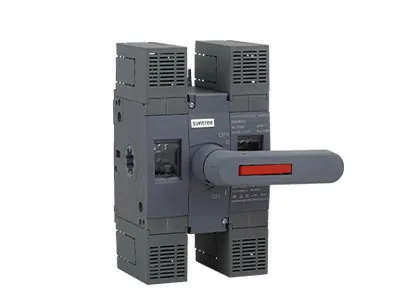
Double‑pole (2‑pole) isolator switch: Disconnects both the positive and the negative conductors simultaneously. Both poles are operated by the same handle, ensuring simultaneous action.
Key point: A “pole” is one independent set of switch contacts. A 1‑pole switch controls one line; a 2‑pole switch controls two lines at the same time.
The Deciding Factor – Is Your PV System Grounded or Ungrounded?
This is the core determining factor when choosing between a 1‑pole and a 2‑pole DC isolator.
Grounded Systems
In traditional grounded PV systems, the negative conductor is intentionally connected directly to earth. In this configuration, only the ungrounded conductor carries voltage with respect to earth.
-
Choice: A 1‑pole isolator is sufficient. You only need to disconnect the ungrounded conductor.
-
Important: The NEC prohibits installing a switch or breaker on a grounded conductor, because doing so would turn that originally grounded conductor into an ungrounded, live conductor, creating a safety hazard.
Ungrounded Systems – Most Modern PV Installations
Modern PV systems increasingly adopt ungrounded designs, especially when paired with transformerless inverters. In such systems, neither the positive nor the negative conductor is directly grounded.
-
Choice: A 2‑pole isolator is mandatory.
-
Reason: NEC Section 690.13 requires that all ungrounded conductors be disconnected simultaneously. In an ungrounded system, both the positive and negative are ungrounded conductors; therefore, both must be opened together.
NEC 690.13 core requirement: The disconnecting means shall simultaneously open all ungrounded conductors. For a typical ungrounded PV system, this means that the DC disconnect must open both the positive and negative poles in a single operation.
What If You Use a 1‑Pole Switch in an Ungrounded System?
This is dangerous and non‑compliant. Here is what happens:
When the 1‑pole switch opens the positive line, the negative line remains connected. Because the system is floating, the negative conductor may carry full voltage with respect to earth. This creates:
-
Shock hazard: Maintenance personnel may mistakenly believe the circuit is fully de‑energised when only one pole is open.
-
Equipment risk: The remaining connection may allow unintended current paths.
-
Code violation: It fails to meet the NEC requirement for simultaneous disconnection of all ungrounded conductors.
Critical warning: In an ungrounded system, opening only one pole leaves the other pole still live – this is not “partial isolation”, it is a “false sense of safety”.
Other Factors to Consider
While the system grounding type is the deciding factor, a few practical considerations may also influence your choice:
Cost
A 2‑pole switch is generally more expensive than a 1‑pole version. However, for ungrounded systems this is not an “option” but a “mandatory requirement” – the safety improvement far outweighs the cost difference.
Space
A 2‑pole switch is usually larger and requires more installation space. This should be taken into account during the design phase.
Monitoring
Some 2‑pole isolators come with auxiliary contacts that can send the switch status signal to the inverter or a monitoring system, enabling remote indication of whether the switch is open or closed.
Multi‑pole Configurations
In addition to 1‑pole and 2‑pole, 3‑pole and even 4‑pole DC isolators are available. For example, a 4‑pole switch can be used to disconnect two PV strings simultaneously. In multi‑string systems, multiple 2‑pole switches can be used to control each string individually.
A Simple Rule of Thumb for Most Installations
If you are unsure whether your system is grounded or ungrounded, choose a 2‑pole isolator. It works for all configurations and is always safer.
More specifically:
| System Type | Recommended Switch | Reason |
|---|---|---|
| Grounded | 1‑pole | Only the ungrounded conductor needs to be opened |
| Ungrounded | 2‑pole | Both poles carry voltage to earth; both must be disconnected |
| Uncertain | 2‑pole | Works for all cases and provides maximum safety |
Remember: For ungrounded systems, a 2‑pole switch is not “recommended” – it is “required”.
How to Identify Your System Type
If you are not certain whether your system is grounded or ungrounded, you can confirm it using these methods:
-
Check the inverter datasheet or system design drawings: Look for the terms “Grounded” or “Ungrounded”, or look for a GFDI device.
-
Inspect the combiner box: See whether the positive or negative conductor is connected to the grounding busbar.
-
Check the inverter type: Inverters with an isolation transformer are typically used for grounded systems; transformerless inverters are usually designed for ungrounded systems.
-
Refer to the inverter manual: The manual usually clearly states whether the PV input is floating or allows grounding.
Frequently Asked Questions (FAQ)
Q1: Can I use two 1‑pole switches to simulate a 2‑pole switch?
Technically yes, but you must ensure both switches are operated simultaneously. This is generally not recommended because it introduces the risk of one switch opening while the other remains closed, leaving one pole live.
Q2: Does a 2‑pole DC isolator protect against ground faults?
No. A 2‑pole isolator only disconnects both poles simultaneously; it does not detect or protect against ground faults. Ground fault protection requires dedicated GFDI devices or isolation monitoring devices.
Q3: Are there 3‑pole or 4‑pole DC isolators?
Yes. They are used for multi‑string PV systems or when signal lines also need to be disconnected. For instance, a 4‑pole switch can control two separate PV strings.
Q4: Do the two poles of a 2‑pole switch have to be wired in series?
Not necessarily. Two common applications of a 2‑pole switch are:
-
Parallel use: One pole for the positive conductor and the other for the negative.
-
Series use: The same conductor passes through both poles in series to increase the voltage withstand capability.
For PV applications, the standard practice is to use one pole for the positive and the other for the negative.
Summary & Next Steps
Choosing between a 1‑pole and a 2‑pole DC isolator boils down to whether your PV system is grounded or ungrounded:
-
Grounded systems → a 1‑pole isolator is sufficient.
-
Ungrounded systems → a 2‑pole isolator is mandatory.
-
If in doubt → choose a 2‑pole isolator for maximum safety and compliance.
For modern ungrounded PV systems, a 2‑pole DC isolator is not an option – it is a safety‑critical and code‑compliant necessity. It not only satisfies NEC 690.13 but also provides the essential protection for maintenance personnel.
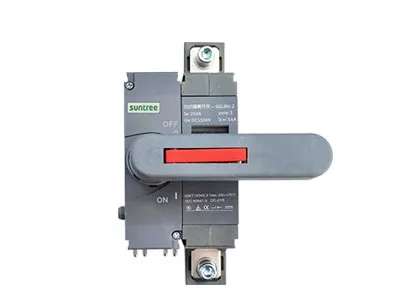
Explore SUNTREE’s range of 2‑pole DC isolator switches, available for 1000V and 1500V systems.