 English
 Bahasa Melayu
 Suomen kieli
 عربي
عربي  Português
 Français
 Pусский
 Español
Why is My DC MCB Tripping? 5 Common Causes in Solar Combiner Boxes


A frequently tripping DC miniature circuit breaker (MCB) in a solar combiner box is more than just an annoyance—it represents lost revenue from unharvested energy and, more critically, a potential safety hazard. While an occasional trip is normal during extreme fault conditions, repetitive nuisance tripping signals an underlying issue that requires immediate investigation.
This guide outlines the 5 most common causes of frequent DC MCB tripping, moving beyond the simplistic assumption of "too much current." For each cause, we provide field-tested diagnostic methods to help you restore solar combiner box system reliability.
1. Persistent Overload Beyond the MCB Rating
The most straightforward cause is also the most overlooked: the string current simply exceeds the MCB’s rated capacity for extended periods. Unlike instantaneous short-circuit trips, overload trips have a time-delay characteristic (thermal trip), meaning they occur after several minutes or hours of sustained overcurrent.
How to Spot an Overload Condition
Do not rely on the inverter’s reported current alone. Use a true-RMS clamp meter (DC mode) to measure each string’s current at the combiner box terminals between 11:00 AM and 1:00 PM on a clear, sunny day. If the measured current consistently sits at 95-110% of the MCB’s rated current (e.g., 10.5A on a 10A breaker), you have a persistent overload condition.
What Causes Unexpected Overload
-
High-albedo environments: Snow cover, white roofing membranes, or ground-mounted arrays near reflective water can boost module output by 15-30% above STC ratings.
-
Over-sizing the PV array: Adding more modules to a string without correspondingly upgrading the DC MCB.
-
Module mismatch or degradation: Bypassed diodes in some panels can force higher current through remaining healthy strings.
Solution: Re-string the array to reduce current per string, or replace the DC MCB with the next standard higher rating (e.g., 10A → 15A), ensuring the cable gauge remains compliant.
2. High Inrush Current from Inverter or Loads (Nuisance Tripping)
This is the classic "nuisance trip" that confuses many technicians. The MCB trips not because of a sustained fault, but because of a momentary surge of current when the inverter starts up, or a large DC load (like a variable frequency drive) switches on.
Identifying Inrush-Related Tripping
Look for these distinct patterns:
-
Tripping occurs within 1-2 seconds of the inverter starting its morning sweep or reconnecting after grid fluctuations.
-
The same MCB holds perfectly fine during midday operation.
-
No visible damage or heating on the terminals.
Why Some MCBs Are More Sensitive
Standard thermal-magnetic DC MCBs are designed to trip instantly on magnetic force when current exceeds 5- 10 times the rated value. However, modern high-efficiency inverters with large input capacitors can draw inrush currents of 20-50x rating for a few milliseconds. This appears to the MCB as a dead short.
Hydraulic-magnetic (thermal-delay) DC MCBs are far superior in PV applications. They are temperature-stable and have a controlled time-delay curve that ignores short-duration inrush while still responding to actual short circuits.
Solution: Replace standard thermal-magnetic breakers with photovoltaic-rated, hydraulic-magnetic MCBs (e.g., Carling Technologies, Eaton, or SUNTREE PV series) that specify "high inrush immunity."
3. Loose Connections or Poor Contact
A seemingly "weak" MCB that trips randomly without a clear current pattern is often the victim of its own terminal connections. Loose screws or poorly crimped lugs create high resistance, which generates heat. That heat travels internally into the MCB’s bimetal strip, causing a thermal trip at currents well below the rated threshold.
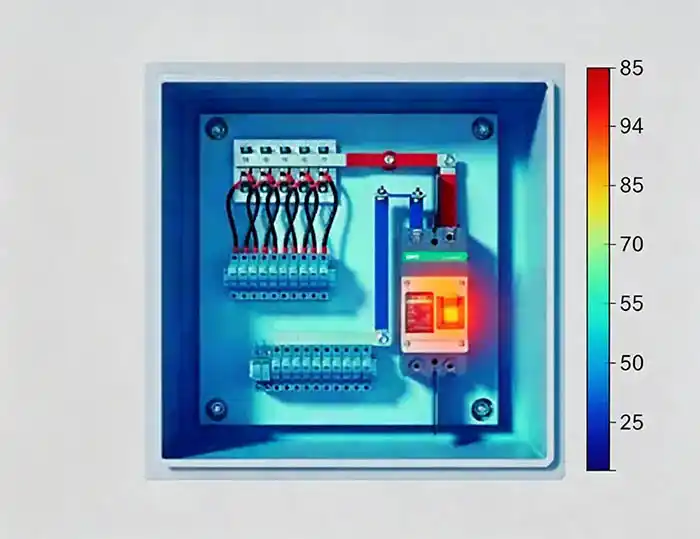
Using Thermal Imaging for Detection
A thermal imaging camera is the single most effective tool for diagnosing this issue. During normal operation (strings producing at least 50% of rated current), scan the combiner box.
-
What to look for: A single MCB where the top or bottom terminal is >15°C (27°F) hotter than adjacent MCBs on the same string.
-
Critical sign: A hot terminal but a cool wire body indicates internal resistance at the connection point.
[Image: thermal image showing one DC MCB terminal at 78°C while others are at 45°C, clearly indicating a loose connection]
ALT Tag: thermal image showing a loose connection causing DC MCB overheating in the solar combiner box
The Right Torque Matters
Most field failures trace back to under-torqued screws. A terminal tightened to only 1.0 Nm instead of the required 2.5 Nm can increase contact resistance by a factor of 10.
Solution: Disconnect the string, remove the wire, clean any oxidation, re-strip to the correct length, and torque to the MCB manufacturer’s specification (typically 2.0–3.0 Nm for 10-32A DC breakers). Re-scan with thermal imager to confirm temperature drop.
4. High Ambient Temperature Inside the Combiner Box
PV combiner boxes are often mounted directly on the back of arrays or on exposed rooftops. On a 40°C (104°F) day, internal box temperatures can easily exceed 70°C (158°F) due to solar radiation and self-heating from busbars.
How Heat Affects Trip Threshold
Thermal-magnetic breakers rely on a bimetal strip that bends as the current heats it. When the ambient air is already hot, the bimetal starts in a pre-bent state. Consequently, the breaker will trip at a lower current than its label indicates. A 15A MCB in a 70°C environment may trip consistently at just 12A.
Improving Ventilation and Shading
-
Immediate fix: Ensure all ventilation slots are unobstructed. Add a sunshade hood above the combiner box to reduce radiant heating.
-
Permanent solution: Switch to hydraulic-magnetic MCBs, which have a flat trip curve from -30°C to +85°C. They do not degrade with temperature.
-
If keeping thermal breakers, use a temperature derating factor of 0.8 for boxes above 60°C (i.e., use a 16A breaker for a 12.8A actual max current).
5. Internal Wear or Damage to the MCB
DC arc faults are far more destructive than AC faults. Every time a DC MCB interrupts a real short circuit (not a thermal overload), a plasma arc erodes the silver-alloy contacts and degrades the arc chute. After a limited number of operations, the breaker’s trip characteristics drift.
Signs of End-of-Life
-
The MCB feels loose or gritty when toggling the handle manually.
-
It trips immediately upon resetting, even with the string isolated (no load connected).
-
All other causes (current, connections, temperature) have been systematically ruled out.
The Swap Test
This is the definitive field diagnostic:
-
Identify a healthy MCB on another string that never trips.
-
Swap positions: Place the "suspected bad" MCB into the healthy string’s slot, and the "known good" MCB into the problem string’s slot.
-
Operate the system for 48 hours.
-
If the problem follows the MCB (the previously healthy string now trips), the MCB is damaged and must be replaced.
-
If the problem stays with the string (original string still trips with the known-good MCB), the issue is external (overload, connection, or temperature).
A Simple Troubleshooting Sequence
When responding to a "frequent tripping" service call, follow this sequence to avoid wasted time and misdiagnosis:
| Step | Action | Expected Outcome |
|---|---|---|
| 1 | Log trip times – Ask the operator or check the inverter logs. Morning vs. noon vs. random? | Morning → Inrush. Noon → Overload/Heat. Random → Connection or bad MCB. |
| 2 | Measure the string current at peak irradiance using a clamp meter. | Below MCB rating? Proceed. Above rating? Cause #1 (Overload). |
| 3 | Thermal scan all terminals and bus connections. | ΔT >15°C between terminals? Cause #3 (Loose connection). |
| 4 | Measure internal box temperature with a probe or thermal camera. | >60°C (140°F)? Cause #4 (High ambient heat). |
| 5 | Perform a swap test between the suspected MCB and a known-good adjacent MCB. | Fault moves with MCB? Cause #5 (Internal damage). |
Frequently Asked Questions (FAQ)
Q1: Will a higher-rated DC MCB (e.g., replacing 10A with 16A) solve the tripping problem?
A: Not necessarily. If the cause is persistent overload (Cause #1), yes—upsizing is appropriate if wiring supports it. However, if the cause is loose connections (Cause #3) or high temperature (Cause #4), upsizing only masks the danger. The loose connection will continue to heat, now potentially exceeding safe limits before the larger breaker trips. Always diagnose first.
Q2: How many trips before replacement is recommended for a DC MCB?
A: For short-circuit trips (magnetic, instantaneous), replace after 5 operations or any single interruption above 10kA. For overload trips (thermal, slow), the breaker may tolerate 50+ cycles, but internal wear is cumulative. Best practice: Replace all DC MCBs in combiner boxes every 5 years in hot climates or after any visible discoloration.
Q3: Is morning tripping different from noon tripping in diagnostic value?
A: Yes, significantly.
-
Morning tripping (within 1 minute of inverter start) → High inrush current (Cause #2) or a failing MCB with degraded magnetic trip (Cause #5).
-
Noon tripping (after 1+ hour of steady production) → True overload (Cause #1) or high ambient temperature derating (Cause #4).
-
Random tripping at any time → Loose connection (Cause #3) producing intermittent heating.
Summary & Next Steps
Frequent DC MCB tripping is never "normal." While it’s tempting to simply swap in a larger breaker or ignore intermittent trips, doing so risks fire from undiagnosed loose connections or degraded components. The five causes covered here—overload, inrush, loose connections, high ambient heat, and internal wear—account for over 95% of field failures.
Your action plan: Download the SUNTREE PV Diagnostic Quick Reference Card, which includes torque specifications, thermal imaging temperature limits, and a one-page decision tree for DC MCB tripping.
Optimized for commercial solar O&M teams. For site-wide assessments or replacement MCB samples, contact your regional SUNTREE technical representative.