 English
 Bahasa Melayu
 Suomen kieli
 عربي
عربي  Português
 Français
 Pусский
 Español
What Is the NEC Requirement for DC Arc Fault Protection on Rooftop Solar?


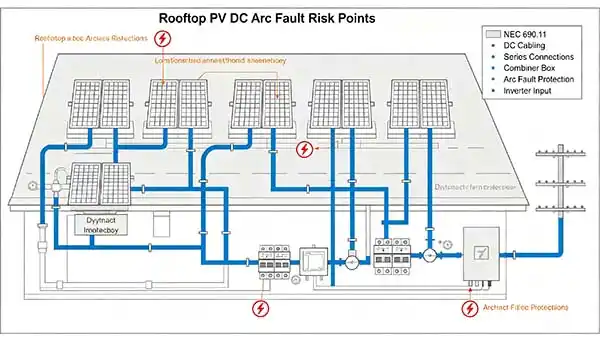
The National Electrical Code (NEC) has specific requirements for DC arc-fault protection on rooftop photovoltaic (PV) systems. These requirements, codified in NEC Article 690.11, are designed to protect buildings and their occupants from fire hazards caused by dangerous electrical arcs in solar DC circuits. Since the 2011 code cycle, most rooftop solar installations with DC circuits operating above 80 volts have been required to include arc-fault circuit interruption (AFCI) protection.
This article explains the NEC requirements for DC arc-fault protection, helping installers, system designers, and compliance professionals ensure their rooftop solar projects meet current code standards.
Which Code Section Covers It?
NEC Section 690.11 is titled “Photovoltaic DC Arc-Fault Circuit Protection.” It was first introduced in the 2011 edition of the NEC and has been updated in every subsequent code cycle.
The section requires that PV systems with DC source circuits or DC output circuits operating at a maximum system voltage of 80 volts or greater be protected by a listed DC arc-fault circuit interrupter (AFCI) or other system components listed to provide equivalent protection.
Importantly, the AFCI device must be listed to UL 1699B — the specific UL standard for photovoltaic DC arc-fault circuit protection — not UL 1699, which covers AC systems only. UL 1699B covers devices including PV DC arc-fault circuit-interrupters (AFCI), arc-fault detectors (AFD), interrupting devices (ID), and inverters with integral arc-fault protection.
Which Systems Are Required to Have AFCI?
Voltage Threshold
The requirement applies to PV systems with DC circuits operating at 80 volts or greater. This threshold covers the vast majority of residential and commercial string inverter systems.
Location
The requirement applies to PV systems installed on or in buildings. Rooftop solar arrays are the primary target of this requirement.
Note: In NEC 2014, the phrase “on or penetrating a building” from the 2011 edition was removed, broadening the scope. The intention was to recognize that fires can occur in ground-mounted arrays as well. However, ground-mounted systems remain largely exempt under certain conditions.
Exceptions
The following systems are generally not required to have DC AFCI protection:
-
Ground-mounted systems
-
Microinverter-based systems — because the DC voltage on the DC side of each module typically remains below 80 volts
-
Systems that do not enter the building
-
Systems with DC circuits in metallic raceways — though this exception has been narrowed in recent code editions
Important: The 2023 NEC removed certain exceptions that previously allowed PV circuits in metallic raceways to be exempt from AFCI requirements. Installers should verify current requirements with their local Authority Having Jurisdiction (AHJ).
What Must the AFCI Do?
NEC 690.11 specifies four core requirements for DC arc-fault protection systems:
1. Detect and Interrupt Arc Faults
The system shall detect and interrupt arcing faults resulting from a failure in the intended continuity of a conductor, connection, module, or other system component in DC PV source and output circuits. This covers both:
-
Series arcs — caused by broken conductors, loose connections, or cracked wires
-
Parallel arcs — caused by insulation failure between conductors at different potentials
2. Manual Restart Required
The system shall require that the disabled or disconnected equipment be manually restarted. Automatic restart is not permitted — a qualified person must physically reset the system after an arc-fault event.
3. Visual Annunciation
The system shall have an annunciator that provides a visual indication that the circuit interrupter has operated. This indication shall not reset automatically — it must remain visible until manually cleared.
4. Disable Function Only by Qualified Personnel
The system shall have a means to disable the AFCI function only by qualified personnel. This prevents unauthorized or accidental deactivation of critical safety protection.
How Is Compliance Typically Achieved?
Inverter with Integrated AFCI
Most modern string inverters include integrated DC AFCI functionality. This is the most common compliance path for rooftop solar installations. The inverter’s AFCI must be listed to UL 1699B for the specific operating voltage.
Examples include SMA’s Sunny Boy series and Tesla’s inverter AFCI mechanism.
Standalone AFCI Device
For systems with inverters that lack integrated AFCI, standalone arc-fault detectors can be installed in combiner boxes or elsewhere in the DC circuit. These devices must be listed to UL 1699B.
Panel-Level RSD with AFCI
Some module-level power electronics (MLPE), including certain rapid shutdown devices and power optimizers, integrate arc-fault detection functionality. However, not all RSD devices include AFCI — only those explicitly listed for arc-fault protection can satisfy NEC 690.11.
What Is Not Required by NEC 690.11?
NEC 690.11 does not require:
-
Ground-fault arc detection — that is the responsibility of ground-fault detection and interruption (GFDI) systems covered elsewhere in the NEC
-
AC-side arc detection — AC arc faults are covered by different code sections
-
Module-level arc detection — protection can be at the string or inverter level
-
Detection of glowing connections — UL 1699B explicitly excludes glowing connections from its scope
Changes in Recent NEC Editions
NEC 2011 (First Introduction)
NEC 690.11 was first introduced, requiring PV systems on or penetrating a building with DC circuits ≥80V to include listed arc-fault protection.
NEC 2014
The phrase “on or penetrating a building” was removed from the section, broadening the scope of the requirement.
NEC 2017
Clarified that AFCI reset must be manual. The requirement explicitly applied to circuits “on or penetrating a building”.
NEC 2020
Expanded requirements to include certain non-rooftop but accessible arrays. AFCI protection now extended beyond dwellings to any building where listed AFCI equipment exists for the application.
NEC 2023
Key updates include:
-
Strengthened AFCI standards for fire safety
-
AFCI protection now extends beyond dwellings to any building where listed AFCI equipment exists
-
Removal of certain exceptions, including the metallic raceway exemption
-
Added requirements for AFCI self-test functionality in listed devices
As of early 2026, approximately 20 states have adopted NEC 2023, with NEC 2020 still in force in most of the Southeast and some jurisdictions still enforcing NEC 2017. Installers must verify which code edition their local AHJ enforces.
Frequently Asked Questions
Q1: Does my existing system need to be retrofitted with AFCI?
A: Code requirements are generally not retroactive. However, if you perform a major modification to an existing system, the AHJ may require the modified portion to comply with current AFCI requirements. Always check with your local AHJ before proceeding with upgrades.
Q2: Can a rapid shutdown device act as an AFCI?
A: Not automatically. Rapid shutdown (NEC 690.12) and arc-fault protection (NEC 690.11) are complementary but distinct requirements. Rapid shutdown de-energizes the array for firefighter safety; AFCI detects and interrupts arc faults. Only devices explicitly listed for AFCI functionality (to UL 1699B) can satisfy NEC 690.11.
Q3: What happens if an inverter’s AFCI trips due to nuisance tripping?
A: The system shuts down and requires manual reset. If nuisance tripping occurs frequently, the root cause should be investigated — common causes include poor MC4 connector crimps, loose terminals, electromagnetic interference, or outdated firmware.
Critical: Never disable arc-fault protection to stop nuisance trips. Doing so violates NEC 690.11, voids equipment warranties, and removes the only protection against DC arc-fault fires.
Q4: What is the difference between UL 1699 and UL 1699B?
A: UL 1699 covers AC arc-fault circuit interrupters for branch circuits. UL 1699B is the specific standard for photovoltaic DC arc-fault circuit protection. PV AFCIs must be listed to UL 1699B — UL 1699 compliance alone is not sufficient.
Summary & Next Steps
Key Takeaways
| Requirement | Detail |
|---|---|
| Code Section | NEC 690.11 |
| Voltage Threshold | DC circuits ≥ 80V |
| Applicable Systems | PV systems on or in buildings |
| Exemptions | Ground-mount, microinverter systems |
| Device Standard | Must be listed to UL 1699B |
| Core Functions | Detect & interrupt arcs, manual reset, visual indication |
| Compliance Paths | Integrated inverter AFCI, standalone AFCI, MLPE with AFCI |
For voltage ≥80V rooftop PV systems, NEC requires DC arc-fault protection. This is typically satisfied by a modern string inverter with integrated AFCI listed to UL 1699B.
Next Steps for Compliance
-
Verify your local code adoption — Confirm which NEC edition your AHJ enforces
-
Select listed equipment — Ensure your inverter or AFCI device is UL 1699B listed for the system’s operating voltage
-
Document compliance — Include AFCI details in your permit drawings and system specifications
-
Plan for manual reset — Ensure the system location allows for physical access to reset after AFCI trips
-
Train personnel — Installers and O&M staff should understand AFCI operation and troubleshooting