 English
 Bahasa Melayu
 Suomen kieli
 عربي
عربي  Português
 Français
 Pусский
 Español
Why Does a DC SPD Status Indicator Change Color Without a Lightning Strike?


You walk past the combiner box on a clear, dry day. No storm last night, no grid event on the logs—yet the status window on the DC Surge Protective Device has turned from green to red. The immediate question is obvious: if nothing hit the system, why has the SPD failed?
The short answer is that a DC SPD status indicator does not record events the way a fault logger does. It reflects the cumulative condition of the internal protection element. That condition can deteriorate through mechanisms that have nothing to do with a direct lightning strike: repeated small transient events, sustained system voltage abnormalities, thermal stress from enclosure conditions, and the natural aging of the metal-oxide varistor (MOV) inside the module. Understanding what the indicator actually monitors—and what it does not—is the first step toward making the right maintenance decision.
What the SPD Status Indicator Is Telling You
Normal Operating Indication
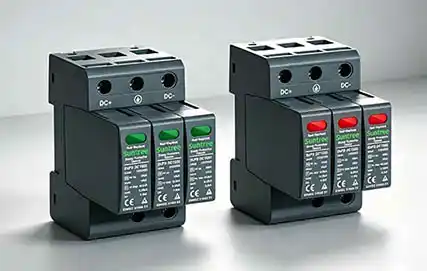
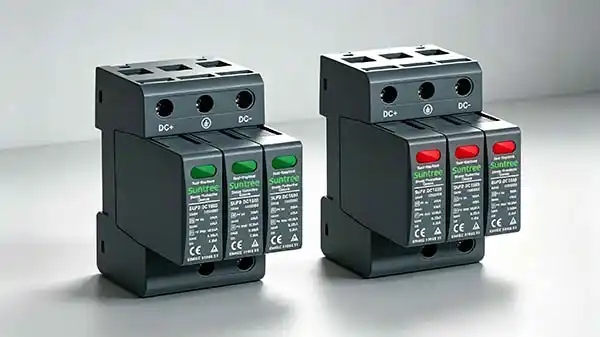
On most DC SPDs used in PV systems, a green status window means the module is still in service: the internal disconnector has not operated, and the SPD remains available to clamp transient overvoltages. This does not mean the SPD is performing at its original specification. A green indicator confirms only that the end-of-life mechanism has not yet triggered—it is not a performance certificate.
Fault or Replacement Indication
A red window almost universally signals that the internal disconnector has opened or the protection element has reached its defined failure state. In practical terms, the SPD module is no longer protecting the circuit and should be replaced. Some manufacturers also use yellow or orange to indicate that the module is approaching end-of-life, while others may show a blank or darkened window when the mechanism has activated.
Why the Indicator Does Not Explain the Root Cause
The status window is a binary or near-binary signal: the disconnector has operated, or it has not. It says nothing about what caused the operation. A red window after a thunderstorm points toward a surge event, but a red window on a calm day could just as easily reflect months of accumulated degradation, a wiring issue, or a system voltage problem. The indicator tells you what happened to the SPD. It does not tell you why.
Why a DC SPD Can Degrade Without a Direct Lightning Strike
Repeated Smaller Surge Events
Not every surge comes from a lightning strike. In PV systems, inverter switching, transformer energization, and routine utility grid operations all generate transient voltage spikes that reach the DC side of the system. Each individual event may be small enough to avoid immediate failure, but the MOV inside the SPD absorbs a portion of that energy every time. Over months or years, this accumulates. Research on MOV degradation under repeated DC switching surges shows that the varistor's energy absorption capability declines progressively with each event, even when no single surge exceeds the device rating.
Abnormal System Voltage Conditions
Temporary overvoltage (TOV) is one of the most common non-lightning causes of SPD failure. A TOV can reach up to 200% of normal system voltage and may result from a utility fault, loss of neutral in a three-phase system, or an improperly configured connection. Unlike a fast surge, a TOV can persist for cycles or even seconds. During that time, the MOV conducts heavily, heats up, and undergoes microstructural changes. Studies on MOV aging under DC temporary overvoltage describe a characteristic pattern: the varistor voltage initially rises, then falls as the double Schottky barrier at the grain boundaries is distorted by ion migration. Once the barrier is sufficiently degraded, the internal disconnector may operate—triggering the red indicator—even though no lightning was involved.
Heat and Long-Term Environmental Stress
The MOV is a temperature-sensitive component. Its long-term reliability follows an Arrhenius-type relationship: operating lifetime decreases exponentially as ambient temperature rises. In a PV combiner box exposed to direct sun, poor ventilation, or high ambient temperatures, the SPD operates at an elevated baseline temperature even under normal voltage. Add the self-heating from continuous leakage current, and the aging process accelerates. Enclosure conditions matter as well: moisture intrusion, dust accumulation, and degraded sealing can all contribute to surface tracking and insulation degradation. Discoloration—yellowing or browning of the plastic casing—is a visible indicator of thermal stress that often precedes actual failure.
What to Check Around the SPD Before Making a Decision
Terminal and Wiring Condition
Before assuming the SPD module itself has failed, inspect the connections. Loose terminals, oxidized wire lugs, or discoloration around the connection points can indicate poor contact, which may mimic or contribute to SPD failure. Field experience with PV SPD inspection consistently emphasizes checking for heat marks, oxidation, and tightness at the terminals. A poor contact can also cause the SPD to see a distorted voltage reference, potentially affecting the indicator status without the module itself being at end-of-life.
Grounding Connection
The SPD's ability to divert surge current depends entirely on a low-impedance path to ground. If the grounding conductor is loose, corroded, or undersized, the SPD may still operate internally but fail to perform its protective function effectively. In some cases, the increased impedance can cause the SPD to experience elevated voltages during normal operation, accelerating degradation. Inspection protocols for PV systems routinely include verifying grounding continuity and checking for excessive impedance at the SPD's ground connection.
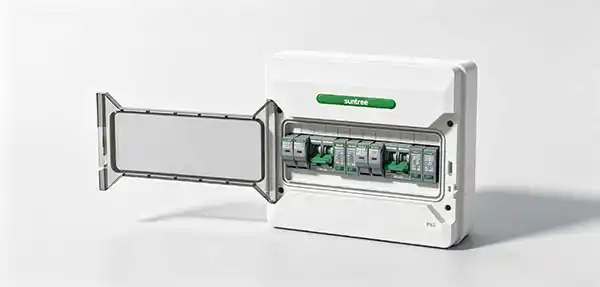
Enclosure Temperature and Moisture
Check the condition of the enclosure itself. Is the interior unusually hot? Is there condensation, water staining, or a musty odor? A failed seal or blocked ventilation can turn a combiner box into a thermal trap, dramatically shortening SPD life. Infrared thermography can quickly reveal abnormal hotspots at the SPD or its terminals. If the enclosure shows signs of moisture intrusion, the SPD should be inspected for internal corrosion or surface tracking even if the indicator still appears green.
What the System History Can Reveal
Recent Inverter Alarms
Most modern PV inverters log DC-side SPD events. A "DC SPD fault" or "SPD alarm" in the inverter event history is a direct record of the SPD's disconnector operating. Checking the timestamp of that alarm against weather records and grid events can help distinguish between a lightning-related failure and a cumulative or system-driven failure. If the alarm coincides with a period of grid voltage instability rather than a storm, the SPD may have been stressed by TOV rather than a surge.
Switching Events or Utility Disturbances
Utility switching operations—capacitor bank switching, feeder reconfiguration, or transformer tap changes—inject transients into the grid that can propagate to the PV system's DC side through the inverter. If the site has a power quality monitor or if the utility has recorded switching events in the area, correlating those with the SPD failure timing can provide valuable evidence. In systems where SPDs fail repeatedly at similar intervals, utility-side disturbances should be investigated as a contributing factor.
Previous SPD Replacements
A history of repeated SPD replacements at the same location is a red flag. If the same position has had multiple SPD modules fail within a short period—say, less than the expected service life—the problem is unlikely to be the SPD itself. The root cause is more likely a system condition: a persistent overvoltage, a grounding deficiency, a voltage rating mismatch, or an environmental issue. In these cases, replacing the module without addressing the underlying condition will simply lead to another premature failure.
When the SPD Needs Further Technical Attention
The decision tree is straightforward. If the indicator has turned red and the module is at or near the end of its expected service life, replacement is the appropriate action. If, however, the SPD fails again quickly after replacement—within weeks or months—the investigation must shift to the system level.
Recurring failures at the same point suggest one or more of the following:
-
Voltage rating mismatch. The SPD's maximum continuous operating voltage (Uc) may be too close to the actual system voltage, causing continuous partial conduction and rapid aging.
-
Grounding deficiency. High grounding impedance forces the SPD to operate at elevated voltages during surge events, increasing stress.
-
Persistent TOV. A utility-side condition or a system wiring issue may be applying sustained overvoltage to the DC bus.
-
Environmental overload. The enclosure may be running hotter than the SPD's design ambient, or moisture ingress may be compromising the module.
In these situations, the correct course is not simply to replace the module again, but to diagnose and correct the system condition that is driving the failure.
Frequently Asked Questions
Can a DC SPD fail without a lightning strike?
Yes. Repeated small switching transients, sustained temporary overvoltage, elevated operating temperature, and natural MOV aging can all cause the SPD's internal disconnector to operate without any lightning involvement. The indicator responds to the condition of the protection element, not to the cause of that condition.
Does a red SPD indicator mean the whole PV system must shut down?
No. The SPD is a protective component, not a functional part of the power conversion chain. A failed SPD does not stop the inverter from producing power. However, the system is unprotected against surges until the module is replaced. For systems in lightning-prone areas or with high-value downstream equipment, prompt replacement is strongly recommended.
Can a plug-in SPD module simply be reset?
No. The red indicator reflects a permanent change in the internal protection element—typically the operation of a thermal disconnector or the degradation of the MOV beyond its service threshold. There is no reset procedure. The module must be replaced with a unit of the same type, voltage rating, and configuration. Attempting to reset or reuse a failed module leaves the system without surge protection.
Summary and Next Action
The status indicator on a DC SPD is a maintenance signal, not a diagnostic tool. It tells you that the module has reached its end-of-service condition. It does not tell you whether that condition was caused by a lightning strike, a gradual accumulation of switching transients, a system voltage problem, or environmental stress. For PV O&M and EPC teams, the practical takeaway is this: replace the module, but also look at the system context. Check the grounding, review the inverter alarm history, and consider whether the site has a pattern of repeated failures. A single replacement solves the immediate problem. Understanding the root cause prevents the next one.
For specification guidance, technical datasheets, or replacement module selection, explore SUNTREE's DC Surge Protective Device range or contact our technical team for application support.